“Younger Adults With Alzheimer’s Are Key To Drug Search”–My Greatest Hope and Fear

lifestyle dementia technology multitasking

I realize there is much controversy about how money should be spent on Alzheimer’s research—whether more funds should go to a cure or go to prevention. Self-interest has kept me hoping that research finds a way to prevent Ralph from the currently inevitable slide into more serious dementia, yet I also have told myself that preventing Alzheimer’s from affecting masses of others is the more altruistic approach.

Then I read the article,“Younger Adults With Alzheimer’s Are Key To Drug Search,”  . Focusing on a 37-year-old woman diagnosed with Alzheimer’s, it claims that testing for certain Alzheimer’s genes could be a crucial part of the research to prevent Alzheimer’s:

“Until recently, people who inherited this gene had no hope of avoiding dementia and an early death. Now there is a glimmer of hope, thanks to a project called DIAN TU  that is allowing them to take part in a study of experimental Alzheimer’s drugs.

The project also could have a huge payoff for society, says Dr. Randall Bateman, a professor of neurology at Washington University in St. Louis. “It’s highly likely,” he says, that the first drug able to prevent or delay Alzheimer’s will emerge from studies of people genetically destined to get the disease.”

I hope Dr. Bateman is correct. But I can’t help thinking about Alzheimer’s in purely personal terms. And really, the pros and cons of the research were not what came to the forefront as I read the story.

All I could think about were my kids. Basically the Alzheimer’s gene is the monster in the room that has scared me too much to acknowledge out loud.

I doubt I am alone in this avoidance. I’ve noticed that children, most of them already grown, receive only passing mention on many spouse caregiver sites devoted to Alzheimer’s. And the heroic children caring for their parents with Alzheimer’s are so busy writing about their concern for those parents that they never mention fears about their own future.

But the genetic connection of Alzheimer’s within families does exist as this article, and many others make clear [“Alzheimer’s Disease Genetics Fact Sheet for the NIA”,   Alzheimer’s genes: Are you at Risk?”,    and a variety of scholarly studies.

The thought that Ralph’s and my kids may be at high risk for developing Alzheimer’s is horrifying.

But the thought of them getting tested horrifies me too. There are all kinds of genetic risks my descendents already face. Cancer, heart disease, and diabetes to name a few. Do they need to be burdened with the certainty, or even the likelihood of Alzheimer’s? I am someone who would rather not know my future (or the future of those I love, especially if that future is going to happen once I’m not around frankly). But my kids are not me. Eventually each will decide what course he or she wants to take.

While I certainly wish Ralph had not developed Alzheimer’s, we are adjusting day by day. In fact, I am fast reaching the point of not quite remembering what life was like before. Alzheimer’s has become central to our life as husband and wife, or as the ever wise Alzheimer’s Wife  recently posted, “part of the bargain.”

The kids didn’t buy into that bargain. But they eventually they may have to own it. It’s not fair, but it’s life.
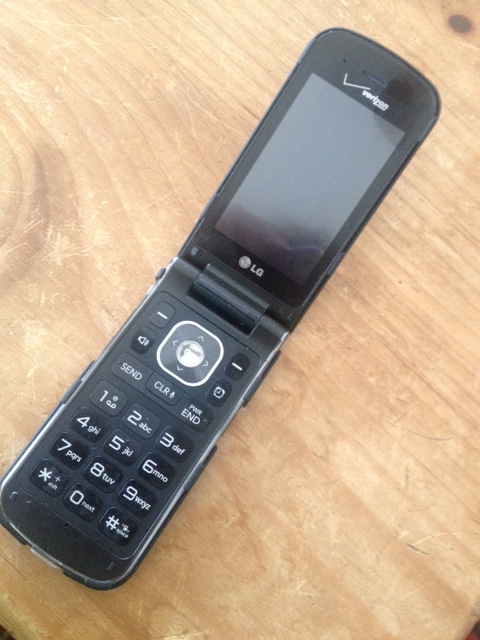
RALPH LOVES TO TALK BUT… PHONE COMMUNICATION WITH THE KIDS

PHONE

The big issues connected to Alzheimer’s and dementia are almost too hard for me to grasp at this point despite the never-ending stream of factual information pouring off the internet and in the media. It is the small moments that capture what it means to live with memory loss.  For instance:

When I get home in a grumpy mood after driving my daughter through rush hour traffic to catch a plane, Ralph is in his usual spot, the front porch rocking chair, with cell phone to his ear. I head inside without stopping to ask whom he’s talking to.

After all, Ralph has his regulars: one loyal friend who checks in weekly, his sister, and the oldest of our three kids.

He talks to his sister almost every day. Both have a lot of time on their hands. Often they can talk for over an hour. Whenever I ask what they talk about, Ralph shrugs. “Small talk.”

He talks to our oldest son almost every day. If Ralph is laughing, but again, I assume it’s Josh, but again when I ask what they’ve been talking about, Ralph says “Small Talk.”

Our much younger two kids love their dad but they are of the text not talk generation. Their phone conversation with their dad are fewer and farther between.

So I was surprised when Ralph came inside and said he’d been talking to our younger son Jacob.

Surprised and pleased until Ralph added, “I called him but he didn’t seem to want to talk. It was a short conversation. I don’t think he likes me. Was I a bad father?”

This is no excuse, but I was hot and tired when I answered with the truth. “Not exactly but not always very nice. You weren’t very supportive.”

Ralph gave me a heartbreaking hangdog smile. “I wish you hadn’t told me.”

“But you asked.” (I know, I know, I could kick myself.)

“You should have lied.”

By then I was already desperately texting with Jacob: Dad said he called but you didn’t seem to want to talk. / Really??? It didn’t seem that way to me but ok / I made it worse because I said he was kind of mean / LOL

Jacob immediately texted Ralph saying he hoped he didn’t sound “out of it” but he’d just  come in after riding his new bike home from work. Evidently they had talked at length about the bike during their not hour-long but not short conversation.

Of course, then I had to figure out to get Ralph to find the text since he never checks for texts on his fliptop unsmart phone.

I waited about twenty minutes, said my phone was dead, asked him to check his because I was expecting a message from our daughter to let us know if she made her flight. He said he didn’t know how. We looked together.

“No message from her, but look there’s one from Jacob,” I said casually and read it to him out loud.

“Why would he send that?”

“I don’t know. Didn’t you talk today.”

“Maybe so. I don’t remember. But this was nice of him.”

Guilt, angst, manipulation, all for nothing maybe. Or maybe not. Ralph went to bed smiling.

Canine Caregiving for Dementia Guide

ralph and dogs

Given how much I talk about Ralph and his dogs, I was glad to happen across this informational site about canine caregivers at Rover.com. Much of the article covers familiar territory about dementia and pets. But the list of where to find canine-caregivers and the information about what a canine-caregiver can offer may prove valuable.

I would love to get our puppy trained as a caregiver, and she is showing signs that she has the patience and intelligence to be a wonderful companion. But if she’s not up to the task of caregiving, I will definitely look into one of these resources down the road.


Alzheimer’s and The Downsizing Decision, So Far Deferred

Driving to the recycling center the other night, I was listening to NPR when a story came on about a man with Early Alzheimer’s. Naturally my ears perked up.

Journalist Greg O’Brien has been chronicling his advancing Alzheimer’s in a series of reports called Inside Alzheimer’s. For those facing their own or a loved one’s Alzheimer’s, especially in the early stages, this series from NPR is worth checking out. A range of subjects are covered from telling the kids to hallucinations, to caregiver anger. Not all the topics may be relevant to your situation but you’re bound to find one that connects.

For me it was definitely the piece the other night. Greg and his wife have decided together that it is time to sell their home on Cape Cod and downsize before his condition deteriorates. Greg talked about packing up with the help of his kids and about the pleasure of finding mementos that vividly brought back to life the family’s past.

As Greg talked, I knew Ralph was sitting at home on the porch listening to NPR and I worried how the story would affect him, wondered if he would compare himself to Greg. Because frankly I was comparing them—the same way I compare Ralph to all of my on-line friends who write such articulate blogs about the early stages of Alzheimer’s.

You are all so strong, so wise, so likable in describing your struggles.

I admit, I can’t help what I know is an unfair thought process: wishing Ralph could be more like you and push himself to live life to the fullest. Of course, I know that I am being unfair. It is as if I am asking Ralph to get over this cognitive glitch, as if he it’s his choice, so he can start remembering and I don’t have to be so responsible.

Greg’s involvement in deciding to sell his home was really hit me because I really don’t know how I am going to get Ralph to leave our farm. And the time is approaching. I spent the morning looking at real estate. I am thinking of moving us, at least part-time to New Orleans where my daughter and her new family have relocated so we can share childcare with Ralphcare.

Ralph knows this, sort of. Sometimes he can analyze the pluses and minuses with helpful perception. Sometimes he thinks spending time down there is a great idea. Sometimes he looks at me as if this new idea, which he is sure I’m presenting for the first time, is nuts.

This possible move of ours is the biggest  financial, emotional and logistical decision I have had to make since Ralph was diagnosed with MCI/Early Alzheimer’s. It affects both of us.

[I would love to hear how those of you in similar situations have decided when a change in housing is necessary–whether it’s been a matter of downsizing, moving into special housing, or even living apart–and how you handled the decision-making.]

Personally, this is the kind of decision I used to let Ralph make. I would offer my advice, would influence his thinking; but for all my feminist posturing, I preferred the more passive role—that way when things went wrong I didn’t have to take the blame.

Well those days are over. Women taking responsibility for our lives is great in theory, and probably in practice–I will explore the definite advantages of feeling empowered in another post soon. Right now I can’t remember what they are. All I am feeling is that I have no choice but to take on the power of decision-making for the two of us, and after a lifetime of back-and-forth compromise (mostly my compromise that I often resented), holding that power can be scary and lonely.

A Sympathy Card and Belated Thank You Note to Joan Gershman, The (Ultimate) Alzheimer’s Spouse

shutterstock_297001781

I just read Joan Gershman’s eulogy for her husband Sid Gershman on her site The Alzheimer’s Spouse. Sid died on June 15.

After twelve years of care giving and eight years of blogging about Alzheimer’s, Joan is taking time to grieve. In her eulogy, Joan is her usual down to earth, self-aware self. And loving in a way I can only aspire to be. Of course, I have often aspired to be more like Joan.

I discovered  The Alzheimer’s Spouse the week that Ralph was diagnosed with Mild Cognitive Impairment/Early Alzheimer’s. With dread I turned to the Internet to read up. I found academic articles, scientific studies, platitudinous advice columns. And then I found The Alzheimer’s Spouse.

This was only two years ago so the Gershman’s were already 10 years deep into dementia’s waters while I was just barely wading the shoreline.

Joan’s site has always been rich with information, but it was Joan’s spirit that grabbed me that night, her willingness to say the unsayable, to bare her wounds and scars. Her spirit and her survival mechanism. I remember sitting at my kitchen table pouring over her posts while Ralph slept in the next room. Here was a role model—a woman facing the reality of her husband’s deteriorating condition, sticking with him, but remaining a person in her own right.

I admit I am no Joan. I am more grudging about care-giving a husband with developing dementia. I am less willing to devote a lot of energy to researching the nooks and crannies of Alzheimer’s care giving in order to stay as up-to-date as I should with current knowledge. But that’s okay—Joan would understand. What I so love about The Alzheimer’s Spuse site is that while Joan has made available a library of knowledge about Alzheimer’s, bthe personal connections and revelations have always been paramount.

Each of us taking care of someone with cognitive impairment realizes that no two cases are the same, that despite statistics and research we each face different challenges.  Yet reading Joan’s words always remind me that we have a lot in common as well.

My Vacation from Caregiving–What Every Alzheimer’s Spouse Probably Needs

I took a vacation from Ralph last week, a road trip through Quebec with my oldest friend. (The photo is Quebec City at night.)Quebec City At Night

Two years ago I cancelled a trip with another friend to Europe just days before I was scheduled to leave because Ralph had an anxiety attack. He had just been diagnosed with MCI and, I realize now, feeling scared about his situation. This time, our niece, who is a nurse, came to stay with her three daughters aged 11 to 21, another nurse friend and my 11-year-old granddaughter. In other words, I could be guilt free about leaving him behind since Ralph was in his idea of heaven: getting lots of attention from  a harem of six charming females without having to leave home. (He did go out for one meal but mostly they brought him back take-out if he refused to accompany them places.)

Of course I did feel guilty anyway. As I walked down beautiful cobbled streets, bought the perfect silver earrings, spent leisurely morning hours reading over croissants and coffee, ate one wonderful meal after another, I could not help asking myself, “Why do I need a vacation anyway? Life with Ralph at this point is just not that hard, especially compared to what other people handle every day.”

Then halfway through the trip my niece texted, “I see why you need a vacation.” Ralph had been asking the same questions repeatedly the way he does when he gets on a jag, and he had been over-feeding the puppy with senior chow immediately after her puppy chow breakfast with predictably unpleasant doggy results. That my niece, a trained nurse, was finding Ralph exhausting was oddly reassuring and empowering. I realized that escaping the daily patience/impatience tension and being able to care for just myself was exactly the break I needed.

The relief I felt was bittersweet. But then I also had to admit another bittersweet reality: that I never much enjoyed travelling with Ralph even before his diagnosis. Our trips together were rarely successful because they brought out certain unavoidable differences in our approach to living. I like(d) to wander and explore. He liked a destination and goal. I enjoy(ed) the adventure of travel, the getting slightly lost, the disasters as well as serendipitous discoveries . He has always preferred to be in control. I even like(d) airports because they’re so divorced from daily life. Airports always made Ralph anxious even before Mild Cognitive Impairment made them overwhelmingly confusing. I used to force him to take trips with me to interesting places. Once we were there, I could seldom relax because I was working too hard to make the experience fun for him.

So much of what I write in my posts implies that I have lost something because of Ralph’s condition, implies a certain marital perfection that just wasn’t the case. I don’t want to idealize our relationship. Coming home I realize I need to face both the reality of the past and of the future. I want to recognize our past for what it was, not with phony nostalgia. Just as I need to recognize the reality of the changes, sometimes small and easy to miss, currently taking place in Ralph  so I can prepare better for the future that is inevitably coming by learning how to work the HVAC, how to spend evenings in solitude, how to travel and enjoy myself in general without guilt. When I come to think of it, I should know how to do all these things anyway.

Ralph and Lola

lola day 1

So we have a new puppy.

Ralph is devoted to his lab Zeus. The two of them spend most of Ralph’s waking hours together, up in Ralph’s office, where Ralph supposedly paints while Zeus dozes, out on the porch where Ralph drinks beer and smokes while Zeus dozes, or at the kitchen table where Ralph eats and reads while Zeus begs for scraps when he isn’t dozing. One reason I can’t get Ralph to go out to dinner, let alone away for a vacation, is that he doesn’t like being away from Zeus.

But Zeus is eleven, maybe older. He has epilepsy. And weighs at least 85 pounds. Big dogs don’t live as long as small ones. So for a while I have been worrying about what would/will happen when Zeus goes. We are not dog buyers usually. Our dogs have come to us through friends or through the pound or because they wondered up tagless. But given the reality of Ralph’s prognosis with Alzheimer’s, I began to think a companion dog with special skills might be in order. Plus I loved the idea of a non-shedding  fluffy dog and maybe a dog that was in the 30-pound range. I also worried that if I waited too long, Ralph would not be able to help with training a puppy—I am not by nature a dog person myself and have never trained a puppy. So last month I registered with a labdoodle breeder to be on the wait list for a mini-doodle puppy.

Evidently a labdoodle is not in my future however.

Because ten days ago I walked into my gym and my Pilates instructor announced she had just picked up a stray puppy and didn’t know what to do with it. The dog had wandered or been dropped at a busy neighborhood intersection. She’d already been to the vet who found no i.d. chip. Everyone in the gym was gaga over the lab mix puppy, which had on a collar but no tags and seemed underweight but not mistreated. With her pale blond coat and dark eyes, she looked like a mini-Zeus. Very mini. Whatever part of her is not lab is something small, a terrier or maybe a beagle. She—my teacher, not the puppy although come to think of it her too—gave me one of her most winning, beseeching smiles. I called Ralph. We agreed to foster the puppy and maybe keep it if no one claimed her. The signs and Facebook announcements were already going up.

Ralph immediately named her Lola, as in “whatever Lola wants…” My granddaughter came to visit and fell in love. So did my daughter. Zeus not so much. Ralph and I tried to keep our distance in case someone showed up. But Lola was, is, awfully cute. No one called. I took her for shots and signed her up for puppy class. She began to house train in earnest.

Which means I am house training her. I am also feeding her and teaching her to sit and come—as far as I’ve gotten in basic dog etiquette. Basically I do all the disciplining and getting up at the crack or dawn and at midnight for “do your business” walks. Ralph cannot keep straight what and when Lola eats or how much to feed or that she needs to go out when she whimpers, but Lola adores him and vice versa. He is the one she sleeps with on the couch. She follows him everywhere when she is not following Zeus, who has gradually learned to tolerate her. I admit I resent that she needs me as soon as I sit down at my computer, and I also resent that she prefers to snuggle with Ralph. It is baby rearing all over again.

But I realize it is good we have a dog to train now rather than later, when it would be too much for Ralph even from the sidelines. I was about to write this up this afternoon when my cell rang.

“Do you have Lola?” Ralph was calling although I thought he was downstairs with the dogs.

“No, you saw me go upstairs.”

“I came up to the barn. I thought you had her and now I can’t find her.” Basically, he couldn’t remember if he took her with him to the barn or left her in the house. I said something snarky that I shouldn’t have and ran downstairs calling her name.

“She isn’t in the house.”

“Stop blaming me. We have to find her!”

Ralph’s calm in a crisis was always one of his signature traits, but not anymore. He began to panic, the way he does these days.

I went outside and called her name but was worried myself. We live on acres and acres of pasture and farmland. It would take no time at all for a small dog to disappear. At the front of the house, I called again. She came running from the direction of the barn.

The good news: Lola comes when called and will probably grow into the perfect companion dog for Ralph. The bad news: I really can’t expect Ralph, who has raised countless dogs over the years, to keep track of the puppy he loves.
ralph and dogs

ps.  Ralph says he thinks we should get the labdoodle puppy for Lola to play with.

A Summer Moment

Here’s a poem for a change of pace. I feel a bit shy posting it here, but It does capture Ralph’s life at this stage of his cognitive impairment better than  a longer explanation perhaps. I have had some trouble with formatting so hope this looks ok….

A Summer Moment

Black birds part the clouds, a river

fast and noisy as Mountain Creek itself

casting its black shadow across the grass.

The noisy rush of wing and throat and beating air

filters through the branches of dogwood and oak.

They come and come and are gone in a rush.

The air goes still.

Out on the porch where you rock and drink beer

the radio talks to you about tornadoes in Texas

and politicians whose name you rarely remember.

The dogs sleep at your feet, their dog breath

thickened by the smoke from your cigarette,

your brain a black river of lost thoughts.

Ralph Makes a Liar Out Of Me–By Reading

Well Ralph has made a liar out of me (probably not the first time, and no doubt not the last).

In responding to Mary Smith’s comment on last week’s post, I wrote that Ralph doesn’t read anymore. And at the time it was true. He hasn’t read a whole book for several months. Similarly, these days the long newspaper or magazine articles he used to relish don’t hold Ralph’s interest because they have too many facts to keep straight. The kind of serious movies we used to see together are often too convoluted for him to sort and remember now; every one we have seen in the last six months has been “too long and confusing.”

He will still ask almost daily for a book recommendation, put the book by his bedside table, but then let it sit there unopened on the growing pile. Yesterday he asked me if he’d already read some 400-page tome on top of the pile, a non-fiction history I knew he’d begun many times. Instead of going through the motions of pretending that monster read was viable, I had a brainstorm and suggested a very short novella, Ashes in My Mouth Sand in My Shoes by Per Petterson, instead. Ralph sat down and finished it in one reading. A young boy’s narration of his relationship with his father, written with childlike clarity, Ashes turns out to be the perfect book for a man with a short attention span to read (or have read to). Actually, it is a lovely book for anyone to read. Petterson writes about children and about men with startling sensitivity. His other books tend to be quite dark (if wonderful), but Ashes is more elegiac and bittersweet. Ralph obviously loved it.

I have been struggling for a while with the dilemma of how to engage Ralph’s interest and exercise his brain, not with any illusions of curing him but because he still likes to be engaged and the old ways don’t work.

And short stories are, well, short. Plus the emotions and psychology they explore require exactly the kind of intuitive response Ralph remains adept at giving. In fact, if anything, he is more intuitive than he has ever been. So after he finished the Petterson, I gave him Tenth of December by George Saunders. Not exactly light fiction and very serious, but as I said, short. And if he reads the same story over twice, who cares. What’s more, since they are short we can both read them and discuss.

I am pretty excited to discover I was wrong to think Ralph was beyond reading. For now, the choices have merely changed, well changed and narrowed….I have no illusions that the narrowing won’t continue, but  enjoy what we can while we can is my new motto.

Learning to Love Ralph’s Mental Check Ups

“We” had “our” six month check up the other day at the Emory Memory Clinic. “We” and “our” are operative words because I probably get as much out of the appointments with our Nurse Practitioner Stephanie as Ralph does. The visits are medical but also psychologically therapeutic and unlike any other doctor visits I have ever experienced.

I admit it never starts well. Ralph asks if we really need to go all the way there (I have learned not to mention the appointment until that morning). And the waiting room time is always uncomfortable, Ralph and I  both secretly looking around at the other couples—everyone present is in a couple whether husband/wife, siblings, parent/child, or cared for/caregiver—trying to guess which person is the patient. I frequently realize I have guessed wrong when the person I assumed was impaired is the one who heads up to the nurse station to sign in. Ralph gets anxious because seeing people with his diagnosis but more advanced into cognitive impairment forces him to consider his own future. I get anxious for pretty much the same reason.

But once we are in the actual room, I am probably more myself than at any other time these days because we are together with someone who knows our situation, who does not look sympathetic but slightly askance at anything we say. This visit Ralph was to have a battery of tests to check his status. The tests take about 45 minutes; I actually thought of sneaking down to the second floor to say hi to a friend who works in the building. Instead those 45 minutes were filled with conversation with Stephanie about my concerns and worries. When I mentioned issues I don’t bring up anywhere else or to anyone else out of some probably misguided mix of embarrassment and guilt—and there are issues I do not bring up in my support group or even here—she responded with matter-of-fact solutions and understanding of someone who has witnessed all the permutations of cognitive impairment. My tendencies toward defensiveness, guilt, and self-justification melted. I could see clearly where I thought Ralph was on the continuum, that his memory seems to have held steady but his energy, curiosity and interest in the world has faded.

And then Ralph returned from his testing in buoyant spirits. He felt he had done really well on the test. And he had. Although he got more questions wrong than he thought, the score on his memory has held steady. (Shout of thanks to Namenda and donepezil.) He still qualifies as Mild Cognitive Impairment and is holding Alzheimer’s at bay.

We are scheduled to return to see Stephanie in six months. She said that if it was inconvenient since we come from a distance, we could skip that appointment. No way. I am looking forward to it.