Tag Archives: MCI spouse

The Wedding

the wedding

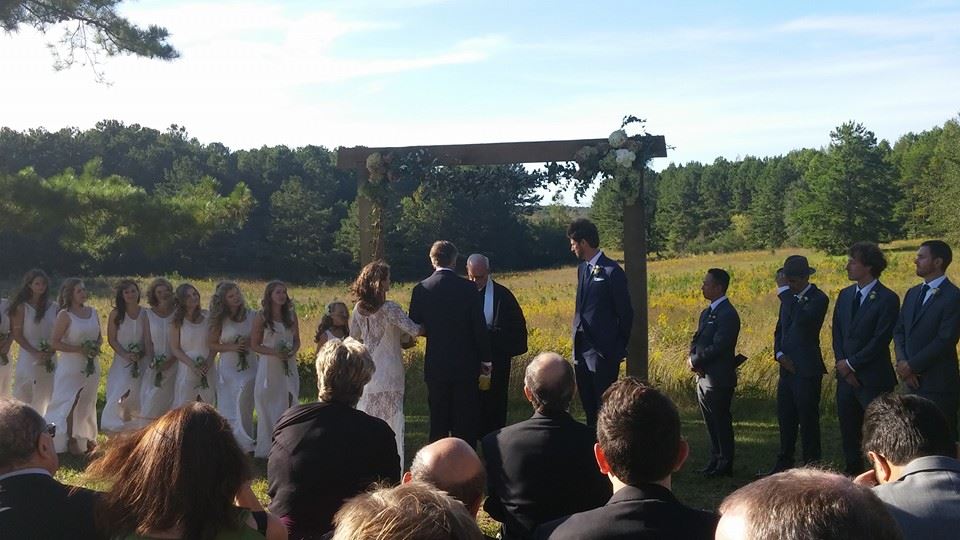
The Wedding last Saturday was…well frankly, it was perfect.

After a stormy Friday, Saturday was sunny and cool. All my daughter’s detailed planning and iron-willed determination to have everything the way she envisioned resulted in a pitch perfect experience—simple but elegant, from the burlap covered hay-bales that guests sat on for the ceremony to the candles that guests lit and floated on the pond. And the emotional intensity was overwhelming, from the way Ralph and our daughter Hilary strode (and I mean strode) down the aisle grinning to the way my daughter included and embraced her ten year-old step-daughter as an integral part of the wedding ceremony, to the tears in the groom’s eyes. Actually there wasn’t a dry eye in the pecan grove. I could go on describing the details forever (like the way Jason rowed Hilary across our pond to the reception).

As for Ralph, he was totally in his element.

For the previous week he had been a wreck, repeating his certainty that the wedding would be a disaster about once an hour and generally unable to keep anything in his head. My impatience combined with my own anxiety didn’t help matters.

Then Thursday night our sons both arrived. The guys live on opposite sides of the country and last saw each other in an airport for fifteen minutes several years ago. Ralph, who is asleep every night by 8:30, sat up with them until three in the morning. I wasn’t about to take that family time away from him, but I was a nervous wreck assuming the beer consumed coupled with exhaustion coupled with tension would leave Ralph unable to function during the important two days to come.

And Friday morning he was still incredibly anxious about the wedding; the intermittent thunderstorms all day didn’t help. But Ralph was also remarkably sharp—what did help was the arrival to the farm of the bridesmaids who paid Ralph lots of attention. (“Why do young girls flirt with me so much,” has become a new refrain, half-boastful, half genuinely curious.)

During the rehearsal, when the minister explained to Ralph that he had a line to say during the ceremony the next day, Ralph was obviously concerned that he might mess up. I was concerned too until I realized that the minister, a good friend who knows Ralph’s situation, would take care of him.

Ralph, whose sense of time gets wobbly, especially when we’re going somewhere he doesn’t want to go, complained how interminable the 30-minute drive to the rehearsal dinner seemed. I was worried. He was clearly dreading the dinner where he would have to interact with more people than he’s used to in a setting that was unfamiliar. I was selfishly dreading embarrassing interactions, afraid he would have a panic attack as he has in the past or even refuse to participate.

But when we walked through the door Ralph transformed. He didn’t have to recognize anyone because everyone knew him. He began to hold court. When the speeches began, he became so inspired that he stood up to give his own toast extemporaneously, regaling us with a story about Hilary and a friend’s escapades. No one who didn’t already know would have had a clue that Ralph has issues with memory. After we got home from the dinner, he stayed up late again with the crowd staying at the farm. Again I worried that he would not be able to function the next day.

And again I was wrong.

Saturday afternoon, when he walked our girl down the aisle, he was completely assured. When the minister asked who gave Hilary away in marriage, Ralph boomed out, “Her mother and I do.” The ceremony went without a hitch. And the reception, full of good food and dancing to a great band, was a huge success crowned by my new granddaughter’s toast, a speech she wrote all by herself that brought down the house.

Ralph had a ball.

He can’t remember any details now. He has no memory of the ceremony having happened. He doesn’t recall the dinner outside under the trees or with whom he danced (and he danced a lot). He does remember the girls paying him attention. And he wishes our sons had hung around longer. We both wonder how he’ll fill his time…but that’s another post.

Mostly he’s let down that it’s over. After months of doom and gloom that the wedding would be disaster, now he’s upset we don’t have an excuse for another party.

Because as he tells me every ten minutes, “You know, I think that went really well.”


Special Delivery

Yesterday, I asked Ralph to stay around the house and watch for a UPS shipment while I took my mother to the doctor and then handled a business transaction concerning the sale of our business. Before I left the house Ralph asked me repeatedly why he needed to stay in the house. Once I was gone, he called me repeatedly asking what he was waiting for and worrying that it hadn’t come. At one point he left the house and waited in the barn, against my specific instructions, until I told him in the next phone call to go back to the house.

His problem was anxiety, not memory, or it was memory compounded by anxiety. But since the package was my daughter’s wedding dress (sent to us so the groom would not see it by mistake), my anxiety got pretty high too. Especially when Ralph stopped calling or picking up his phone when I called him for an hour while rushing home.

Of course once I got home, he was sitting on the porch with the dog and a beer. “Oh yeah, I think something came,” he said when I asked, “That big white box in there?”

Once the package came, it stopped being something he needed to remember so it didn’t occur to him to call and tell me. Besides, he’d left his phone somewhere in the house where he couldn’t hear it ring and needed me to find it.

The bottom line is that Ralph managed fine and the dress is safe. When my daughter nervously texted from her job to ask if it arrived, I couldn’t help teasing her—as if an already tense bride-to-be needed her mother to make things worse.

“If what arrived?” I texted back, before quickly, and guiltily,  texting again, “Safe and Sound.”

The joke’s on me because now I have to wait to open the box and look at the dress until she comes out here on her day off. The anticipation is driving me nuts…it’s a different kind of anxiety than I’m used to these days and one that’s a lot more fun.

Long Term Health Insurance

I usually write personal stories here, leaving the science and practicalities surrounding memory loss to more qualified sources like the Alzheimer’s Association website. But this morning I gave the following advice to a friend who suggested I share it here. If you are reading this blog, you or someone close to you has probably been diagnosed with memory loss and may not qualify for long term insurance, but for the rest of you, especially caregivers, I have three words:  LONG TERM INSURANCE.

It isn’t cheap and the costs and benefits vary according to your situation. But it is easy to research on the government’s long term care site. For balance read the less than enthusiastic report in Consumer’s Report and then visit AARP’s longterm care calculator site. There are several sites that compare rates of providers. I am not saying BUY, but at least look into the possibility.

I will always be grateful to my mother for setting an example before it was too late for Ralph and me to consider long term insurance for our uncertain future.

She purchased long term insurance after my father’s death when she was over 70. Fifteen remarkably independent years later, she fell into a depression and stopped eating. Although we’d spent my childhood, adolescence and young-to-middle adulthood not much liking each other, age mellowed us both into polite if slightly stiff cordiality by the time I flew down to stay with her in the retirement condo Ralph had helped my father purchase years earlier in Key West. Key West, where I’ve had some of the best times of my life including my honeymoon, lost all its pleasant associations during the miserable two weeks that followed. Finally the visiting nurse gave my mother two choices: one, continue starving herself with the understanding that I would not be able to stay as long as it took for her to die; or two, fly back with me to Georgia and get medical care.

We flew to Georgia the next day. For the next nine years, until weakening health required her move into the nursing home where she resides now, my mother lived in the mother-in-law suite fortunately installed in our basement already.

And it was okay, not great exactly, not what my father would have called “a bowl of cherries.” Sure there were crises (like when she called 9-1-1 the night I neglected to go down to say goodnight after getting home from a movie) and the family issues that always arise among near and far adult children when a parent is failing. But what would have been a completely untenable situation, emotionally and practically, worked out only because that long term insurance. offered a financial safety net.

Purchased so late in my mother’s life, the insurance had payment limits and an end-point, which she reached about three years ago. But for seven years Genworth promptly paid about half the salaries of the excellent full-time caregivers we hired. Social security and an annuity paid most of the rest. Her savings held more or less steady—a good thing since her nursing home is not cheap and those savings are coming in handy.

Three years ago when Ralph started getting those notices that he would soon be eligible for Medicare, I suggested we re-examine our insurance situation. Since both of us have always been self-employed, we’ve always kept our cost down by carrying a very high deductible. After all, as Ralph pointed out, we didn’t need more insurance because we were both extremely healthy.

But so was my mother as I pointed out.

We called AARP who recommended Genworth, which happened to be the provider that was working so well for my mother. After some back and forth and a visit from a knowledgeable if less than personable insurance agent, Ralph agreed to go ahead and buy the insurance. He had not been diagnosed back then of course and I was not consciously acknowledging any change; in fact we joked together about his bad memory when we had to take a memory quiz to qualify as low risk applicants for the best policy available. We both passed. I can’t help wondering, if we had waited a year or even six months, would Ralph be insured now?

Thankfully, he is insured. And just as important, so am I. We don’t need extra help right now. But given the way Alzheimer’s progresses, a time may come when Ralph requires more care-taking than I can offer alone. And even now, if my health took a downturn I know I couldn’t count on Ralph to care for me. Having the long term insurance means I don’t have to.

So, at the risk of repeating myself–which I do all the time these days anyway so what’s one more time–consider buying long term insurance as soon as possible.

Decide if you can afford to buy the insurance, and if you can afford not.

A Little Awkward Self-Congratulation

Thank-you Alzheimer’s Wife for nominating me for the “Very Inspiring Blogger Award.” Since you have travelled farther along the road of Alzheimer’s/Dementia/Cognitive Impairment, I am genuinely touched that you find my posts worthwhile.

Having begun blogging just three and a half months ago in late April, I am still learning the rudiments so please forgive me if I screw up while following the Award Rules…well really, there is no excuse but I’m pretty sure I can’t follow the rules completely.

Rule 1.            Thank and link to the amazing person who nominated you.                                      See above for my appreciation of Alzheimer’s Wife who is always loving without pretending dealing with her husband Bo is not difficult. I think it is very important (and very difficult) for caretakers to be realistic about what we can and cannot do. I also want to mention the first blog that inspired me: The Alzheimer’s Spouse, whose chronicler Joan is currently facing the final stages of the battle.

Rule 2.            List the rules and display the award.                                                                                       This one is easy at least. See the award in the sidebar

Rule 3.           Share seven facts about yourself.                                                                                              Ugh, but here goes:

One. I am a city girl whom Ralph dragged kicking and screaming to our rural farm twenty years ago. Now, while I don’t quite fit into farm life, I find the city unbearably noisy and chaotic.

Two. I am 63, Ralph is 67, and we have been married for almost 37 years

Three. That marriage has really been more like three marriages—The first marriage, our first twenty years, was rocky and full of wrangling about everything from child-rearing to politics to the move to the farm; the second marriage included the few years of quiet and reconnection after the kids were out of the house (and despite the arrival of my mother ten years ago); the third marriage has just begun, and I imagine it will slip into a fourth marriage down the road.

Four. I am the oldest of four children and was never close to my mother so it is ironic that she ended up living with Ralph and me for nine years (with the help of excellent in-home care) until we placed her in a nursing home last October at age 96.

Five.  Seeing the importance of Long Term Health Insurance, I made sure Ralph and I purchased it. Ralph thought I was being over-cautious but Thank God we bought it when we did.

Six.  I find giving facts about myself difficult even though I write a blog that goes into intimate detail about my marriage and my life.

Seven. I am not a computer illiterate blogger. In fact I never read a blog until Ralph’s diagnosis when I started Googling for information on Alzheimer’s and Cognitive Impairment. In fact I am technically impaired in general, as Ralph and our children will tell anyone who asks.

Rule 3. Nominate 15 other amazing blogs and comment on their posts to let them know they have been nominated.                                                                                                                                       See the seventh fact above. I have to admit I don’t follow that many other bloggers. But among those few I have discovered so far and not counting those above, the following are my two favorites, bloggers I’d like to hang out with over a cup of coffee and whom I hereby nominate:

Before I Forget  is written by Mrs. Hsg, an incredibly brave British woman who was diagnosed with Alzheimer’s several years ago. Not only is she brave, but she is also funny. And her British take on life is thoroughly refreshing.

Enterthestorm is a new blog written by a woman whose situation sounds uncomfortably like my own. Her posts so far have been straightforward and heartfelt, painful but irresistibly honest to the bone.

Rule 4.  Proudly display the award logo on your blog and follow the blogger who nominated you.

DONE

Sometimes a Little Rant Helps

Okay so I got a little furious at Ralph last night. That’s an oxymoron, isn’t it? Furious implies more than a little anger. But dealing with Ralph since his MCI means that any given moment I cannot allow myself more than a little anger, a little resentment, a little impatience.

Be warned what follows is my little rant. Even as the words show up on my screen, I see how “little” the incidents were that set me off. But if you are dealing with a loved one with cognitive impairment (or anyone who has ever been married), you know the way those little moments build.

Ralph and I drove into Atlanta yesterday so Ralph could try on a new suit for our daughter’s wedding. He said he didn’t want to go (“too complicated” as usual), but once we were at the store with our daughter, he started enjoying himself. He basked in our compliments about how good he looked, he told the salesman stories about his wild youth. Back at my daughter’s house, she and I got on the computer to order wedding knickknacks while Ralph relaxed with a glass of wine (and a smoke on the porch).

Since the three of us were laughing away, having more fun together than we have in ages, my daughter and I assumed that when her fiancé got home, we would all share an early dinner at one of their neighborhood restaurants. I had mentioned the plans in a vague way to Ralph, the way I have learned to mention most plans ahead of time, and he had seemed amendable.

But when my daughter made the understandable mistake of asking Ralph directly whether he was willing to hang out another half an hour, he said, “No, I want to get home to my dog.”

My heart sank. I knew that if we’d waited to mention dinner until the arrival of my daughter’s fiancé, whom Ralph is crazy about, Ralph would have gone along with the idea and then had a great time. But it was too late now. When I gently suggested that dinner out might be a nice change of pace, he became adamant about going home. I didn’t push. So at the height of Atlanta rush hour, we got in the car.

Slipping into the driver’s seat I asked, only half joking and barely pleasantly, if we were ever going to eat out in Atlanta again. He answered with the rhetorical question, why would we want to. Well that’s easy, I thought but did not say out loud, because we have always loved going to restaurants together, because I am as obsessed with food as I was when he me, because I am sick of cooking every night, then sitting in front of Jeopardy while we eat. I bit my tongue and said only that it might be a nice change of pace.

For the next few minutes we drove in seemingly pleasant silence—Ralph oblivious to my private stewing over being cheated out of a good meal—but then I suggested we take a different route to the interstate, one I know but Ralph doesn’t remember, so we would avoid the heavy traffic that comes after five.

A big mistake. Since I was driving I should have kept my mouth shut and just gone the way I wanted. Ralph again became adamant. He said my way was further than his way, that I was wrong about the time it would take. His voice rose with his anxiety. Before his diagnosis, I would have argued back, and screaming would have ensued. Instead I followed his route knowing it would be a disaster.

The tension barometer in our car rose not helped by my audible sigh with each minutes that clicked by. After sitting in the same line of unmoving cars for thirty minutes, Ralph turned to me and full of contrition said, “I forgot how back traffic gets. Next time you should just override me because you know better.”

Guilt immediately washed over me. How could I be mad at a guy who so willingly apologized and acknowledged his limitations?

Well, I could. I might be guilty about it but I was still mad. Mad because I was craving a nice meal out. Mad because planning the wedding has been a difficult but special time for all of us and I wanted this chance to share a sense of celebration with the two lovebirds. Mad because we were now stuck in traffic when we could be halfway home if I’d taken that left turn I’d wanted (and we’d be halfway through dinner by now if gone out with the kids). I was mad because I gave in unnecessarily. Oh wait, was I mad at him or myself?

I began writing this post with threads of resentment still clinging to my psyche. Petty bickering and small issues that blow out of proportion are part of most marriages; they were certainly part of ours before Ralph’s diagnosis. But they feel different now, complicated by moments of condescending pity knotted with bursts of affection and flashes of appreciation for the man Ralph remains. Complicated most of all by my own ambivalence at becoming what I always thought I wanted: the one in power, the one in control.

Memory Loss and Money Matters

Yesterday I met with our new financial planner—Ralph would never have accepted the idea of a financial planner before now— and I was so anxious about the meeting that I left my laptop at the coffee shop where I’d just had lunch. Fortunately the coffee shop found my computer, and our retirement account is earning exactly the return the planner promised.

Money is not a subject I find comfortable to discuss. I have always been the artsy/intuitive, some in my family might say ditsy spouse. Even after I started working part-time in Ralph’s business office, using QuickBooks to make deposits, pay the bills and balance the books, I maintained the persona of Earth Mother not Business Woman. My domain was feelings; Ralph’s was the bottom line and money matters. (One important exception: using the example of my mother who used her coverage for her health aides, I successfully pressed Ralph to purchase long-term care insurance four years ago. Thank God.)
Since Ralph’s diagnosis, I have been thrust into the weird position of trying to think the way Ralph used to think about business and money. Well, that is not quite accurate because as I sort out our finances, I sometimes find myself disagreeing with the decisions he made.

Especially those he made in the last few years as his memory began to slip from his grasp. He had slacked off, clinging to outdated business habits and letting his assistant make more and more decisions. When she moved away and I became more actively involved at Ralph’s office, I saw the reality: while I worked ten hours a day, he came in at 11am and left at 3pm with an hour for lunch; he sat in his office reading magazines while I handled all the day-to-day matters. And yes, I was resentful to put it mildly. Still we continued to pretend he was in charge. He didn’t want to believe otherwise and frankly neither did I.

Then came the diagnosis of MCI/Early Alzheimer’s and suddenly there was no pretending we could go on as we had. We agreed that our longtime accountant and lawyer needed to know about Ralph’s condition early on. We quickly updated our wills and made sure that powers of attorney, including responsibility for health decisions, were in place.

As for Ralph’s business, the retirement that we had talked about, yet avoided for so long was now mandatory. Since Ralph’s business for the last 35 years had been managing rental properties he owned, selling the business meant selling individual properties one at a time, no simple matter.

As we began the process of talking to real estate agents and taking offers, it quickly became clear that Ralph couldn’t keep straight which real estate agent was which, which property was under contract, how much we should be asking, or how much was being offered. To tell the agents or buyers our situation would place us at a disadvantage, so I have found myself covering for him and acting as a kind of pseudo-go-between.

What has evolved is a kind of charade. The agents may not know officially about Ralph’s condition, but they have to sense something is odd. Ralph chats with them jovially, but I’m the one who responds to the offers. Ralph and I discuss the sales as if he is equally involved in the decision-making, but actually he cannot remember the details long enough to analyze them, so I make decisions with the help of our accountant and lawyer.

I have learned to be a tough bargainer, which I hate. I have learned to say no, which is incredibly difficult. I have learned to play on others’ sympathy, which has not been so difficult. Aging feminist that I am, I kind of like playing the helpless female.
And I have learned to manage our money, sometimes in ways that Ralph would not have accepted. While I have involved our son, another artsy type but with Ralph’s hardheaded business sense, in some meetings, ultimately I have made the tough decisions on my own. I had three closings in the space of six weeks. A fourth property is under contract now. I turned over some of our property to another management company that rented our office in the city. I now have an office at home.

Every day or so, sometimes three or four times within an hour, Ralph asks how much money we have in the bank. I tell him. Then he asks if we’ve paid off our mortgage. I tell him yes. Then he asks if we have enough to live on. I tell him yes again. Ralph, who used to walk and talk calculations down to the smallest fraction, doesn’t want to know details. He’s always satisfied with my answers. He trusts me completely.

Before MCI, I used to chafe at his controlling nature and complained that he didn’t trust my judgment. But the truth is, I was glad to shirk financial responsibility off on him. Now I have it, and it is lonely and scary, like so much of what being Ralph’s wife has become.

Is MCI Dementia?

Several weeks ago Ralph and I sat down with a bowl of popcorn and watched the program “Alzheimer’s – Hope for Tomorrow – Help for Today” on our local public television station. Ralph’s doctor was featured as well as a member of Ralph’s support group.

Despite the optimistic title and some upbeat patient interviews, the program didn’t sugarcoat or patronize those of us in the trenches. After all, for all the studies and research and media attention, the known facts are pretty clear-cut: There’s no sure way to predict when/if MCI and early Alzheimer’s will develop into full-on Alzheimer’s; and there’s no cure despite the drugs and lifestyle changes that slow down the progression for some but not all patients.

It was like watching a car wreck; only the wreck involved my car. I couldn’t tear myself away.

Ralph watched all the way through too, but when I asked him what he thought he said he hated the program. His exact words were “It’s all crap.”

He didn’t want to identify with the people he saw on the screen, even those who seemed to me even less impaired than he is.

What probably put him off most—what frankly made me squirm sitting beside him—was the constant referral to both Alzheimer’s and MCI as dementia.

I have been squirming ever since. DEMENTIA. That’s how to describe Mrs. Rochester in Jane Eyre, the crazy woman in the attic, or my 96-year-old mother in her worst moments. Not Ralph, my careful, rational husband, a fact man who loves historic detail and likes nothing better than to analyze current events. It has never occurred to me to use that scary word dementia for Ralph’s condition…or only in anger and before his MCI diagnosis (when I so easily tossed around damning words that choke in my throat now).

It has taken weeks to steel myself to look into the definition of dementia in terms of MCI. The U.S. National Library of Medicine site lays out the parameters very clearly:

“Mild cognitive impairment (MCI) is the stage between normal forgetfulness due to aging and the development of dementia. People with MCI have mild problems with thinking and memory that do not interfere with daily activities. They are often aware of the forgetfulness. Not everyone with MCI develops dementia.

Symptoms of MCI include:

  • Difficulty doing more than one task at a time
  • Difficulty solving problems or making decisions
  • Forgetting recent events or conversations
  • Taking longer to do more difficult mental activities

Early symptoms of dementia can include:

  • Difficulty with tasks that take some thought, but that used to come easily, such as balancing a checkbook, playing games (such as bridge), and learning new information or routines
  • Getting lost on familiar routes
  • Language problems, such as trouble with the names of familiar objects
  • Losing interest in things previously enjoyed, flat mood
  • Misplacing items
  • Personality changes and loss of social skills, which can lead to inappropriate behaviors”

No surprise that Ralph hits the mark for all four symptoms of MCI.

As for symptoms of dementia, he’s a mixed bag. Fortunately, he does not exhibit any symptoms of moderate dementia so I didn’t reprint them. Comparing him to the early symptoms list I can say confidently that he has no language problems, at least less than I do, and that he doesn’t misplace items any more than he always has, although finding his razor in his sock drawer this morning was perplexing.

He can still drive his tractor and do carpentry repairs. But there’s no getting around that he can no longer do mental tasks that used to come easily–forget balancing a checkbook, he struggles following a movie. He is beginning to forget how to get to once familiar destinations, so I am going with him to get his teeth cleaned next week. And his personality has definitely changed. My “to the moon Alice” Ralph has transformed in an easygoing, appreciative, sentimental, even docile Ralph who is also withdrawn and fearful of anything outside his daily routine.

Although there’s no way to avoid checking Ralph’s behavior against the definition of dementia from now on, I am not ready to add dementia to the vocabulary of my marriage (a resistance I’ll explore in a future blog). And I don’t believe I have to.

Not yet.

Will We Walk the Alzheimer’s Walk?

Receiving an email reminder of the Alzheimer’s Association Walk to Stop Alzheimer’s coming up in a few months, set off a chain of reactions  I  jotted down as they were hitting my brain…bumpbumpbump…

1. I want to go on the walk. It will be a good thing to raise money for research of course, but what really appeals to me is the sense of belonging the walk implies. I imagine myself in a bright-colored t-shirt surrounded by smiling new friends.

2. I can’t sign up. Ralph will refuse to participate. If I bring it up he’ll say “just send money.” He walks every day with his dog or with me., but with other people? Other people with varying stages of Alzheimer’s: No way. He doesn’t want to be part of that world.

3. Actually, he’s not that stubborn.  I probably could convince him to participate. I could say his doctor says we should . No, I don’t have to manipulate him that way. If I’m honest and say that the walk is something I want to do, he’ll probably go along; he likes pleasing me these days.(a smile of affection  at that thought)

4. But if I do convince Ralph to walk, he won’t want to walk with other people. We would be a lonely twosome. I get support from knowing others in the same boat, while being around people with cognitive impairment only scares Ralph. And this difference is not just because he has the impairment; it also has to do with his personality versus mine. Not everything has to do with the impairment.

5. But Ralph was the extrovert for the first twenty years of our marriage. I used to resent how easily he met people. Our roles have reversed after all.

6. Maybe it’s not a great idea. Maybe I’m still too shy to walk with strangers. Maybe I’ll just send a check. Why push against my natural inclination and his current comfort zone.

7. But how can I not walk? We need to own this reality.

8. I am not sure why this walk seems so important. I have plenty of time to decide; three months can bring a lot of changes (or very few). But   this one small choice, like every small choice, crystallizes the back and forth in which I spend so much of my inner life these days.

9. And besides I keep imagining those new friends.


Travel–My First Crisis as an MCI Spouse

One of the sticking points in our marriage has always been that I love to travel but Ralph doesn’t, unless it’s to go fishing. So I was incredibly excited last spring, just over a year ago, when a friend invited me to accompany her family on a cruise through Northern Europe. Two weeks all expenses paid! Even my airfare would be covered!

Aware this might be my last chance for an adventure, I was dying to go. Ralph had been given the neuropsychologist’s initial assessment of MCI by then and we had recently visited the Emory Memory Clinic for the first time. But except for repeating himself a lot, Ralph was pretty much the same self-sufficient guy he’d always been– working in the office every day, fishing with his pals, arguing about politics. I told myself he could certainly manage  without me. Still good wife that I considered myself, I told my friend that I couldn’t commit until I spoke to Ralph.

I brought up the trip with trepidation, not sure how he’d react. He might not enjoy travel himself, but he didn’t much like being left behind either.

“No question, you’ve got to go.” Ralph’s enthusiasm surprised me. “This is an offer you can’t refuse.”

He seemed more relaxed than I was  during the flurry of preparations. Over the next month I bought walking shoes, stocked the freezer with the frozen potpies Ralph loves, planned a long fishing weekend to keep him occupied at least part of the time while I was gone.

Then Ralph woke up one up one morning, five days before I was to fly to London, and announced angrily that if I went on this trip, I might as well not come back. I lashed back at him with resentment and plenty of anger of my own. How could he wait until the last minute? What would I tell my friend and her family? Why was he such a controlling bastard?

“It’s your decision,” he said before storming out of the house.

We headed to our shared office in separate cars. The cadre of supportive, well-meaning woman friends I called as I drove all agreed: Ralph was being ridiculous; he might have minor memory issues but he could function alone perfectly well.

I eventually called the Memory Clinic for professional back up; after all, I had heard our neurologist say that Ralph had ONLY MILD Cognitive Impairment.

Talk about a bucket of water in the face!  Both the nurse practitioner and social worker explained what I should have realized—capacity to function aside, Ralph’s fear had to be respected.

I went to him and apologized. He said if I really wanted to, I should go after  all. Then we talked with more honesty and intimacy than we’d shared for a long time. He acknowledged fears that his condition would suddenly get worse—“What if I get lost while walking in the woods by our house and you’re not here to find me?” “What if my mind just goes out all of a sudden?” It didn’t matter that neither scenario was likely; his anxiety was genuine and intense. And for this proud man to admit any fear was huge.

Which meant I had to admit my own fear: my own high anxiety about my new role as caretaker-spouse of a husband with memory loss. I had been in selfish denial about Ralph’s MCI while planning my trip, but part of me knew all along that going away for more than a couple of days would be a mistake. Once I said I wasn’t going, I was oddly relieved: What had I been thinking to plan such a trip?

My friend refused to let me feel guilty about cancelling. Her father refused to let me pay him back for the non-refundable tickets. The kindness of strangers is nothing compared to the kindness of friends.

As for the two weeks I didn’t travel to Europe, I have no regrets. In fact those two weeks were a gift because I ended up going with Ralph on that long fishing weekend I had organized for him, along with my daughter and her boyfriend, and while we were all together, they got engaged. Now if I’d missed that….

I Meet Another MCI Spouse

We are a little early for Ralph’s third of five sessions in an Emory University study on visual aids on whether certain visual clues will improve memory retention for those with MCI/Early Alzheimer’s. (There are so many studies out there right now and they all need volunteer subjects. But not every patient qualifies to be in a study. MRIs are usually required and there are often other restrictions as well but it is worth going to the Alzheimer’s Association website to check out what studies are going on in your neighborhood.)

Ralph’s study is concentrated over a two-week period. Ralph says the “homework” aides the researcher has recommended don’t help but he has returned willingly enough. I don’t sit in during the sessions but I come alone for moral support and read old magazines in the drab but not uncomfortable waiting room.

This afternoon another couple sits down in the waiting room with us before Ralph gets called in. I size them up: both husband and wife are a little older than us, probably early seventies, casually but tastefully dressed, whispering and smiling at each other with just an edge of nervousness that says they are first timers. She is lively and chatty, he more passive. Like Ralph.

But a few minutes before Ralph goes off with his researcher, another researcher comes for the wife. The husband and I are left together with the dated magazines. As we begin to chat about the weather and the time it took to get to the building, I am dying to bring up the obvious—if both of our spouses are in this study, they must both have the same diagnosis—but I don’t want to intrude on his privacy.

Before I can stop myself the letters M, C, and I are out of my mouth.

Yep, his wife is about a month behind “Ralph” in the process, not necessarily in terms of her degree of cognitive impairment but in terms of when she was diagnosed. She is seeing Doc L’s partner. She has just started the same drug (donezepril) Ralph is on. Her husband’s not sure what comes next.

I am almost giddy as we start comparing notes. There is so much to talk about that I haven’t been able to share with anyone else. Our hour or two together in that dinghy room flies by. I doubt I’ll ever see him again. I don’t know his name.

But for the first time, I realize I am not alone