Category Archives: Caregiver/Spouse Issues

A Little Christmas Paranoia Ho Ho Ho


IMG_0103IMG_0097


I was driving to the airport with Ralph this afternoonto pick up one of our kids flying in for the holiday and a car swerved around me. One of those jerks going about twenty miles an hour faster than everyone else. At least that’s what I told myself, but it is possible that he was swerving to avoid some bad driving on my part.

I am not the greatest driver in the world—which would not matter except that for the last twenty-five years I have lived in my car commuting at least an hour each way to work, driving kids to school and various far-flung activities. Even the grocery store is a 20-minute schlep each way.

All of which is to say, I had an anxiety what if attack. What if I was in a car accident, or fell on the sidewalk as I am prone to do (broken ankle three years ago, split chin three weeks ago), or ate bad lettuce, or was infected with Ebola.

Usually I worry about myself in these scenarios, i.e. how my life would be affected. But this time my worry was a little different—

What I was out of the picture and Ralph was still here?


[Ok I know this is ghoulish and I am laughing at myself as I write, but holidays bring out my paranoid streak and I need to get the Christmas gremlins out of my systerm. If you don’t feel like humoring me, I understand. Feel free to stop reading here.]


I have set up some plans, one kid with power of attorney for financial matters, another for health issues. However, there is the issue of daily life. If I were not around, Ralph really could not live on the farm alone. He can take care of himself about the same way an 11 year-old boy can—lots of reminding before and cleaning up after. But Ralph is not ready or willing to have a paid keeper. [Odd to think, and I am a little ashamed to admit, that the decision will be easier down the road when Ralph’s condition has deteriorated further and there is no pretending that he can do for himself.]

Our closest kid lives a seven-hour drive away. None of our kids is equipped to have him move in at the moment. Maybe with financial help from the others, one could rearrange his or her living conditions to include Ralph, but as the sibling who cared from my mother in my home, I know how complicated it can be—and she didn’t have Alzheimer’s. I don’t know if I wish that on any of them. On the other hand, I can’t imagine Ralph in a facility without space to roam or his dogs to pet or his cigarettes to smoke.

And his level of anxiety at the idea of any change in his lifestyle (not to mention grief over my absence) would go through the roof.

So the answer is obvious: I have to drive and walk and eat and breathe with much more carefully so I can live forever.IMG_0099
Post Travel Blues

shutterstock_78323365For the last ten days, I was in New Orleans with my 11-year-old granddaughter, and Ralph stayed here on the farm with my son who lives in NYC. Actually, no, I have been back for four days, but I have had difficulty writing down words about how those days affected me.
Because they threw me into a slump I am still trying to crawl out of.

My actual time away was lovely. I drove my granddaughter to school and then spent the day working on final revision on my novel until it was time to pick her up. The rest of the time we played endless games of gin rummy, ate cupcakes, read and wrote—she’s begun her own novel (a little grandmotherly bragging slipping in).

And Ralph seemed fine when I called him multiple times a day. My son worked on his computer during the day, the way I never seem to get around to when I am home. He cooked dinner at night, or tried to—more than once Ralph forgot he was there and ate leftovers without him first—and they sat around talking.

The time together was a real gift for Ralph. My son is over 30, and I doubt they have ever been alone together for more than a few hours before in over 20 years.

It was a more complicated gift for my son. He recognizes that whatever memories he forms with his father now are important. But ….he found being with Ralph really, really difficult.

Although he offered to come again when he could to give me a break, he also admitted he found being with Ralph “annoying.”

“I don’t know how you do it,” he said as I drove him to the airport. The constant repetition, the inability to carry on a logical conversation. “It’s exhausting.”

So here’s what I have avoided writing: For months, years now, people tell me they admire my caregiving and I tell them it is not a big deal because that is what I tell myself, that my life has not changed all that much. But having another person in my shoes, alone with Ralph day after day the same way I am, and having him tell me how incredibly hard it was has thrown me into a tailspin.

I am feeling angry that after ten years of intense caregiving for my mother, I now face years of caregiving my husband. I am sad that after we worked so, so hard to save and improve our troubled relationship, after we found a way to be happy together, this damn Alzheimer’s has already chipped away at so much of it.Having been away, I see more clearly how Ralph is changing in ways I didn’t recognize before (and will write about soon).

And after four days home, I am in fact exhausted.

Ralph’s Famous Adventure in Hog Killing —or Keeping the Stories Alive Despite Alzheimer’s

shutterstock_275552708

I was making dinner the other night when Ralph called me out to the porch where he was having his daily late afternoon cigarette and beer listening to the radio. A story on All Things Considered had piqued a memory from his childhood.

“Have I ever told you about the hog killing?” he asked.

Oh God, not the hog killing story again, I thought as he launched into it. How many times over the years have our kids and I have heard this story–how he was a little kid visiting relatives on a farm with his family one fall during hog killing season, how his easily hysterical mother started shrieking, how the gory killing is mixed into a memory of getting ice cream cones. But it’s a better story in his telling than mine.

“You know you should write that story down,” I told him. “All your stories, actually.”

He nodded. “Yes, I should.”

This conversation is not a new conversation. Every few weeks we agree he has a lot of great stories, and is (or was) a natural storyteller of the Southern charm variety. I suggest he get a notebook and write the stories down. He says, yes, he definitely will do that.

But given Ralph’s inertia fed by his place on the Alzheimer’s spectrum, that’s only going to happen if I make it.

And so far I have been a slacker. I tell him and myself I will get a notebook and set aside time each day for us to work on stories, but then I let the whole idea slip off my radar as quickly as it slips from his. His excuse is cognitive impairment. Mine is laziness at making one more effort. The discipline it will take for me to get him to get the stories down is the same discipline I need—and have so far lacked—to get him to exercise more. His lack of enthusiasm gets me off the hook and feeds my own penchant for lethargy.

But I am making early New Year resolutions. I need to get Ralph walking before he puts on more (not to mention my inches and pounds). More important, I cannot wait until Ralph and I are both inspired to record, whether on audio or in writing, his stories.

Because otherwise the day will come when I ask him to tell me one or he tries to remember, and the story is gone.

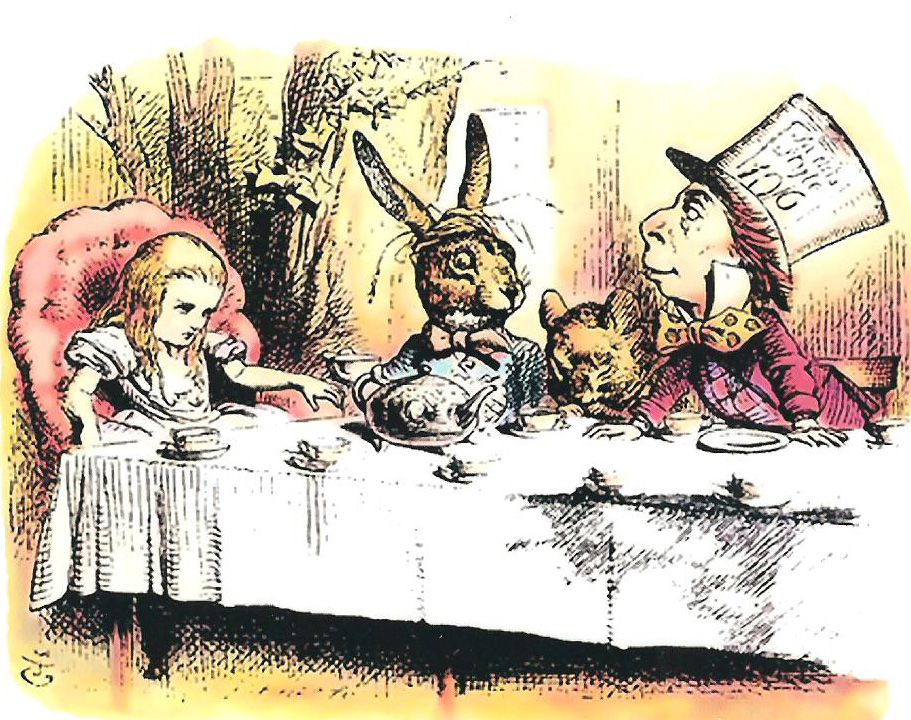
Alice Has a Pity Party

Mad-Hatter-Tea-Party

When friends compliment me for being patient and nurturing toward Ralph I have to laugh. Empathy for others easy, empathy for Ralph not so much.

Especially today. Maybe I can blame the bad cold I’ve come down with, but I feel like griping. I don’t blame you if you don’t feel like sharing my self-pity party, and if that’s the case, you might want to stop reading now.

I just spent the morning re-ordering his meds, which never arrived last week. I ordered refills weeks ago and have assumed they were on the way but when I went to feel his weekly box, I realized they still haven’t come and we are getting dangerously low. Evidently Ralph removed the post office’s post-it note without telling me I needed to pick up a package. The package got returned, we’re down to less than a week of some meds and I was on the phone with the mail order pharmacy working out how to get his meds for half an hour. In the old days, I would have yelled at Ralph for forgetting to tell me because he wasn’t paying attention, but how can I now, knowing it’s not his fault.

Then I re-organized the clothes in Ralph’s closet yet again. One of the more recent hints of slippage has been sartorial. He was never a snazzy dresser, but he was vain about his admittedly good looks. Now whatever is closest at hand is what he puts on. I no longer bother reminding him about the separation between work and dress clothes, but I do try to steer him in the right direction, mostly by having fewer choices visibly available.

Then I dug out a few Natty Lites from my secret hiding place and put them in the fridge for later this afternoon. Ralph more or less accepts this system for limiting his daily alcohol consumption although he’s remarkably able to find my hiding places, his memory and sense of direction still acute where beer and cigarettes are concerned.

This is all so trivial, and I know others’ problems concerning Alzheimer’s, not to mention poverty, hunger, war, are much worse. But I have noticed that managing these silly daily tasks with their subtle reminder of something amiss, something out of balance, sometimes drains more energy and patience  than dealing with Ralph himself. Or that after taking responsibility for the practical details of Ralph’s life, my patience for dealing with the man himself is compromised.

But as I said, I have a cold.

So I’m off to make myself tea and toast and pretend I have someone to take care of me for a little while.tea

A Benefit of Ralph’s Cognitive Impairment–My Strengthened Self?

men-wanted-bargains-1433910-639x454

Last week I posted information about a study concerning the impact of Alzheimer’s on women. Since then I have found myself thinking in a more deeply personal way about how I have been impacted, specifically in terms of my sense of identity as a woman.

My (even) more self-centered than usual thoughts are flowing after spending a weekend with an old college talking and eating non-stop (the eating important since the setting was New Orleans).

Jane and I explored the challenges that shaped us over the last thirty years and the directions in which we are currently evolving. We talked a lot about whom we have each become and why. It turns out that we have remained alike in many ways—our politics, our private and social ethics, our taste in food, even our TV preferences.

But there is a major dividing line: I have a husband and children. She doesn’t.

In college, despite high ambitions and avowed feminism, we shared a tendency to let men we loved take over our lives including those ambitions. (Ironically, the fact that we were at different times drawn to the same young man brought us closer as friends.)  In our twenties, we each married a charismatic if self-absorbed man with big ambitions of his own.

Then our life paths diverged.

Jane’s marriage lasted only a few years. After the divorce, she went on to have an extremely fulfilling life with an exciting career and plenty of important friendships and relationships. After Jane’s early marriage to a dominating man ended in divorce, she went on to have an extremely fulfilling life with an exciting career and plenty of important friendships and relationships. She has her regrets, but she has developed an amazingly strong individual identity, which includes confidence that she is a woman who can take care of herself. She is not certain that she could have become that woman within the confines of a marriage.

My marriage—to Ralph—has lasted and my primary identity became tied up in being a mother and a sometimes resentful wife struggling not to be overshadowed by Ralph’s powerful personality. I fought to forge my own identity, eventually publishing several books including my first novel.

But I never put my ambitions first and in our shared life, I usually let Ralph get his way in decision-making. I would rail against the decisions he made—like to move us to a farm or buy a certain car—but I always went along. And when one of Ralph’s decisions went bad, as they sometimes would, I could always think not my fault.

Jane did not have that luxury. She had to make every practical and metaphysical decision concerning her life on her own, and then she had to live with the consequences.

So now she is a woman used to making decisions for herself, used to the tension and the fear and the joy, and I am a woman learning to make those decision for myself and for Ralph.

Making decisions alone requires a mental muscle I never adequately developed and now have to exercise. Ralph no longer has any interest in making decisions. Along with memory loss, his mild cognitive impairment has caused a major personality change. He is the passive one who cheerfully, and without the resentment I used to feel or any questioning, goes along with whatever I say.

I am not downplaying the reality of Ralph’s cognitive impairment and its negative aspects. But learning to cope with Ralph’s condition has created a potential for growth for me as a woman. It is scary and intimidating to be the decider, also liberating. I am learning what Jane learned over the last thirty years: to be strong-willed, self-reliant, independent, and in charge of my own happiness.

THE ELASTICITY OF TIME–DEMENTIA AND MY TRIP TO THE DENTIST

shutterstock_246443827

I was waiting to get a tooth pulled the other day, breathing nitric oxide into my nose while my teeth were held in a kind of vise, when I had an epiphany of understanding…. I realized I was experiencing something akin to how Ralph lives everyday.

Sitting immobile in that over bright, antiseptic office I had nothing else to do but turn inward. And frankly ideas began to percolate. I became completely caught up in my flow of ideas—how to re-organize my novel-in-progress now that my first (Playing Botticelli) is getting re-formatted as an e-book and my second (Inheritance) is out being shopped; how to deal with the HVAC guy who put the wrong size AC unit into my house, causing unspeakable damage; how to organize a campaign against Donald Trump; how to improve this blog. I didn’t care that there was no way to articulate my thoughts or that they flew out of my brain and away like birds from an open cage.

Fifteen passed minutes , maybe five minutes, maybe half an hour while I floated in time. It occurred to me, not for the first time, how expansive time can be when untethered from routine. I was living totally inside my head, and time had temporarily had no weight. I knew the dentist would come in eventually, but I didn’t know when and I didn’t really care. My sense of living in the present, chemically created in the dental chair, may be as close as I can get to what I imagine Ralph and others living with his kind of memory loss dementia experience all the time.

Or I’d like to think so because I like to think that Ralph is experiencing a rich inner life of thoughts and feelings teven if he cannot hold on to them long enough to express them to me.

Last night, for instance, he talked on the phone to our daughter for what seemed to me a good half an hour. Sitting beside him, I watched his face full of animation as he listened to her sort through some issues she is having and offered his advice, as he laughed at things she said and made jokes of his own.

He was so fully involved in the conversation that I was frankly a little jealous, dying to talk to her myself. But I didn’t ask for the phone because it was better to let him be the parent she talked to for a change.I am sure my daughter hung up believing she and Ralph had completely connected.

As soon as he put the phone away, I immediately pounced, asking him the basic questions I knew she’d answered—like whether or not she was going to take the job she was telling him about, and when exactly was she arriving for her visit this week.

He shook his head. “I can’t remember if she said.”

Of course I can get the answers myself from a quick text back and forth. As for the gist of their conversation, and what I really wanted to know….

              “It sounded like a good conversation. Did she seem happy?” I asked.

               He shrugged. “I think so. It’s hard to tell. She didn’t have much to say. We only talked a minute.”

A Sympathy Card and Belated Thank You Note to Joan Gershman, The (Ultimate) Alzheimer’s Spouse

shutterstock_297001781

I just read Joan Gershman’s eulogy for her husband Sid Gershman on her site The Alzheimer’s Spouse. Sid died on June 15.

After twelve years of care giving and eight years of blogging about Alzheimer’s, Joan is taking time to grieve. In her eulogy, Joan is her usual down to earth, self-aware self. And loving in a way I can only aspire to be. Of course, I have often aspired to be more like Joan.

I discovered  The Alzheimer’s Spouse the week that Ralph was diagnosed with Mild Cognitive Impairment/Early Alzheimer’s. With dread I turned to the Internet to read up. I found academic articles, scientific studies, platitudinous advice columns. And then I found The Alzheimer’s Spouse.

This was only two years ago so the Gershman’s were already 10 years deep into dementia’s waters while I was just barely wading the shoreline.

Joan’s site has always been rich with information, but it was Joan’s spirit that grabbed me that night, her willingness to say the unsayable, to bare her wounds and scars. Her spirit and her survival mechanism. I remember sitting at my kitchen table pouring over her posts while Ralph slept in the next room. Here was a role model—a woman facing the reality of her husband’s deteriorating condition, sticking with him, but remaining a person in her own right.

I admit I am no Joan. I am more grudging about care-giving a husband with developing dementia. I am less willing to devote a lot of energy to researching the nooks and crannies of Alzheimer’s care giving in order to stay as up-to-date as I should with current knowledge. But that’s okay—Joan would understand. What I so love about The Alzheimer’s Spuse site is that while Joan has made available a library of knowledge about Alzheimer’s, bthe personal connections and revelations have always been paramount.

Each of us taking care of someone with cognitive impairment realizes that no two cases are the same, that despite statistics and research we each face different challenges.  Yet reading Joan’s words always remind me that we have a lot in common as well.

My Vacation from Caregiving–What Every Alzheimer’s Spouse Probably Needs

I took a vacation from Ralph last week, a road trip through Quebec with my oldest friend. (The photo is Quebec City at night.)Quebec City At Night

Two years ago I cancelled a trip with another friend to Europe just days before I was scheduled to leave because Ralph had an anxiety attack. He had just been diagnosed with MCI and, I realize now, feeling scared about his situation. This time, our niece, who is a nurse, came to stay with her three daughters aged 11 to 21, another nurse friend and my 11-year-old granddaughter. In other words, I could be guilt free about leaving him behind since Ralph was in his idea of heaven: getting lots of attention from  a harem of six charming females without having to leave home. (He did go out for one meal but mostly they brought him back take-out if he refused to accompany them places.)

Of course I did feel guilty anyway. As I walked down beautiful cobbled streets, bought the perfect silver earrings, spent leisurely morning hours reading over croissants and coffee, ate one wonderful meal after another, I could not help asking myself, “Why do I need a vacation anyway? Life with Ralph at this point is just not that hard, especially compared to what other people handle every day.”

Then halfway through the trip my niece texted, “I see why you need a vacation.” Ralph had been asking the same questions repeatedly the way he does when he gets on a jag, and he had been over-feeding the puppy with senior chow immediately after her puppy chow breakfast with predictably unpleasant doggy results. That my niece, a trained nurse, was finding Ralph exhausting was oddly reassuring and empowering. I realized that escaping the daily patience/impatience tension and being able to care for just myself was exactly the break I needed.

The relief I felt was bittersweet. But then I also had to admit another bittersweet reality: that I never much enjoyed travelling with Ralph even before his diagnosis. Our trips together were rarely successful because they brought out certain unavoidable differences in our approach to living. I like(d) to wander and explore. He liked a destination and goal. I enjoy(ed) the adventure of travel, the getting slightly lost, the disasters as well as serendipitous discoveries . He has always preferred to be in control. I even like(d) airports because they’re so divorced from daily life. Airports always made Ralph anxious even before Mild Cognitive Impairment made them overwhelmingly confusing. I used to force him to take trips with me to interesting places. Once we were there, I could seldom relax because I was working too hard to make the experience fun for him.

So much of what I write in my posts implies that I have lost something because of Ralph’s condition, implies a certain marital perfection that just wasn’t the case. I don’t want to idealize our relationship. Coming home I realize I need to face both the reality of the past and of the future. I want to recognize our past for what it was, not with phony nostalgia. Just as I need to recognize the reality of the changes, sometimes small and easy to miss, currently taking place in Ralph  so I can prepare better for the future that is inevitably coming by learning how to work the HVAC, how to spend evenings in solitude, how to travel and enjoy myself in general without guilt. When I come to think of it, I should know how to do all these things anyway.

My Caregiver’s Dream I’d Rather Not Analyze

My dream:

I am at the beach with children, either my kids when they were still young or grandchildren I don’t in fact have yet. A blue sky and the sound of waves. We are having a good time, digging in the sand and building sand castles, throwing a beach ball. Suddenly I realize I don’t see Ralph. I call his name. Since I know he is not much for going in the water, I wonder if he has wandered somewhere? Then I hear muffled noises, look around and find him nearby buried under the sand—buried head and all so I really only see the shape of him under the sand and really only the shape of his head because he [a Freudian slip typo I just noticed and fixed–I originally typed “she”] is buried vertically. But somehow those words are burbling up through the sand. When I scoop the sand away, he is still breathing and talking as if nothing is odd….

How vivid and obviously meaningful this dream is. When I woke up I knew exactly what it meant and how it tied in to Ralph’s Early Alzheimer’s. Then emotional self-preservation  set in and blocked my analytic powers. Now I literally cannot remember what about it seemed so important. But let me try to face, here in real time, why the dream scares me on so many levels:

My panic at Ralph’s initial disappearance

How much fun I was having without him

The indistinguishable noises that were his attempt at words

Ralph buried alive

My power to scoop the sand away

Ralph’s nonchalance after I dig him out

My annoyance that he doesn’t notice and keeps on talking

Ralph’s muffled life


Energy–His, Mine, Ours

It’s a little after noon on Sunday afternoon. Ralph is in the bedroom “resting.” He woke up at eight and we drank coffee until nine so his morning was not exactly demanding. But we are scheduled to meet friends at the movies at 2.

Resting at length in preparation for any out-of-the-ordinary activity has become the norm. He rests all morning the day he takes his art class. He rests most of the day before we go out for dinner. He does not attach his need to conserve his energy to his cognitive issues—well, he doesn’t attach any of his behavior to his cognitive issues, but I think the resting has  to do with controlling his anxiety more than a physical need.

And if it works, great. I certainly don’t fault him for needing to rest for whatever reason. But I am also aware that his need for rest affects my own in ways I don’t like exploring too carefully. Am I as energetic as I could be or am I using his lack of energy as an excuse to be less vigorous in my pursuits as well? When he goes to sleep at eight, I often stay up alone for hours wasting my time on bad television or online robot bridge, telling myself my brain is too taxed to read—it’s not. If I don’t work on revising my novel when he is resting, I tell myself I can’t concentrate because he is in the next room. It is so easy to follow his time line and energy line, to drop down a notch or two on the activity scale. It is a dangerous slope.

Partners in a long marriage either grow together or apart. Given our particular marriage’s ups and downs, it’s a pleasant surprise that Ralph’s Early Alzheimer’s has brought us together in many ways. But I need to be careful. His cognitive failings dominate much of our marriage; I need to be sure not to use him now to let things that matter slide, to avoid the sometimes difficult choice to live my life to its fullest.