Category Archives: Caregiver/Spouse Issues

Diaries and Dementia

diary

I want to pass on a link sent to me by my friend Caregivee, who has become my friend and conscience:

Caregivee sent me information about a new British study, “Carers’ diaries in dementia: Is there a role in clinical practice?”

I cannot verify the validity of this scientific study, which compared information recorded by 78 caregivers in daily diaries to what information caregivers gave in retrospect, but I was particularly struck by one conclusion:

“Our findings suggest that there may be a potential use of carers’ diaries in the assessment of dementia, in that they may identify more problems compared to relying solely on the retrospective account of patients and carers in clinic. More research using carers’ diaries in dementia covering longer period than a week may be required to ascertain other benefits.”

This study seems to suggest that by assembling the details from the diaries of many caregivers’ daily experiences–those small problems and/or solutions  that we forget about once they’ve passed, those fleeting reactions, those moments of clarity–health professionals may find ways to help caregivers improve caregiving and make the experience better for caregivees. We can use all the help we can get.

Although I may write here about my anecdotal experiences with some regularity, I have never been good about keep an actual diary. Perhaps I should start.

(But no promises that I can keep it up.)

Cognitive Impairment and Contentment, An Odd Couple

IMG_0255stress

Ralph and I have our best conversation while driving, the same way my kids and I did, and for the same reasons: we have each other’s undivided attention and we can’t escape.

So of course I was maneuvering my way through rush hour traffic the other day when he brought up his concern that his IQ has dropped seven points since what it was when he was a boy—this statistical tidbit from his first diagnostic testing lodged in his brain three years ago; he’s brought it up occasionally ever since but rarely so bluntly.

I responded that most people’s IQs probably drop as they get older, then added as an afterthought (how I tend to break bad news) that his memory loss has probably made his drop worse. He nodded. When I used the term Mild Cognitive Impairment, he flinched, but only slightly. (We don’t use the word Alzheimer’s aloud in our house.)

He brought up how well his medications Namenda and Donepezil have worked. He also said he was wasn’t worried that eventually they might stop working as well because his doctor had assured him that there will be new drugs in the process being discovered and he can take them when these stopped being effective—I don’t recall the doctor saying that exactly but I didn’t contradict him because, after all, who knows?

Then he took a puff of his e-cigarette and said, “Anyway, I’m content.”

“Did you say content?” I asked.

“Yes, I am very content these days.”

I could tell he meant what he was saying, not “fluffing the goods” as he likes to describe people whose stories he doesn’t believe. I felt glad for him, and definitely relieved.

But also, I have to admit, I was a bit jealous. Ok, a little resentful too.

Because I am not content with my life these days. It’s fine to be told what a good, caring wife I’ve become, but it’s kind of a backhanded compliment coming from friends with exciting careers going full steam ahead. Not that my career was ever that full of steam, but my ambitions have flagged. I find myself drifting along, adjusting my rhythm to Ralph’s, wondering if my own days of productivity are over along with his.

I’d rather blame the heat. Maybe once the temperature drops below ninety I’ll be full of focus and energy again, ready to care for Ralph and myself with equal vigor. I’m going to borrow from Ralph’s new playbook and assume the best….

When Our Light Bulbs Dim–The Literal Ones, Not The Metaphoric

This was our big accomplishment of the last few days: changing ten light bulbs (embarrassing to admit how many and never mind for how long).

I realize how trivial changing light bulbs sounds, but that’s the thing. What used to be one trivial, mindless activity handled along with hundreds of other trivial activities in the course of a day has taken on a new distinct weight given Ralph’s memory loss.

Obviously I could have handled this chore mostly by myself but decided I’ve been letting Ralph slide. Knowing how much to ask of him is a delicate balance, but I haven’t been pushing him enough to participate in our daily life, too often accepting his plea that he’s tired, in part because not pushing is frankly easier for me too. So if he’s been sliding, I have too.

It took me five days to corral Ralph’s attention, but the other morning I got him to walk with me from room to room upstairs and down, noting which bulbs were out and what kind of bulbs were required while I took notes. He unscrewed a fluorescent rod in the kitchen and a decorative bulb from the bathroom vanity to make sure we got the correct replacement sizes. Over the weekend  we drove to the store–I let him drive while I rode shotgun.

In the parking lot he agreed to bring in the fluorescent but became adamant that he didn’t need to take the decorative bulb because he’d remember it. I acquiesced, but once we were on the bulb aisle, the bulb choices overwhelmed us both (evidently, according to a friend I was telling about our excursion, bulb buying has become more complicated  for everyone these days) . Ralph had no idea which decorative bulb matched what we had. Not 100% sure myself and sensing his rising anxiety, I ran back to the car for the example from home. When I got back, Ralph was still in the row where I’d left him and had found a matching fluorescent rod but misplaced the bulbs we’d already picked out (something I might have done myself if if truth be told).

By the time we got home, Ralph was exhausted. I changed the bulbs I could reach. He took a nap. The next morning when I mentioned changing the rest of the bulbs, he gave me a blank look. But once I reminded him that we’d been to the store and here were the bulbs, he happily changed the fluorescent bulb. Then he took a rest. In the afternoon I reminded him again and he willingly changed three bulbs n the kitchen. This morning, I reminded him again and he changed the last ones, including a light on the stairs that was admittedly difficult–especially since one of the new bulbs was a dud–and required a ladder as well as much turning on and off of the switch.

We are now a house of working lights. What a sense of accomplishment!lights kitch15

I’m giving Ralph the rest of the day off, but tomorrow I’m plan on reminding him to change the oil in the lawn mower. It’s been a year.

“So, How Is Ralph Doing?”

question man2


An old friend called to catch up yesterday. We talked for maybe 40 minutes, were nearing the end of the conversation, when she asked, “How is Ralph doing.”

She’d clearly been both hesitant and dying to ask. I had been equally hesitant and dying to answer.

This scenario seems to be repeated in one form or another multiple times a week these days. Everyone who knows, however vaguely, about Ralph’s cognitive problems wants an update but everyone seems slightly uncomfortable asking.

For my part, I am both reticent and overeager to share.

I always find myself answering, “He’s holding steady,” and then launching into all the little negative changes I’ve noticed, interrupting myself to say, “I know this sounds trivial but…”

Because, really, I don’t know how he is.

Ralph is scheduled for his annual testing in two months. As the appointment nears, I find myself thinking about it more and more with both dread and anticipation. (Ralph doesn’t know it is coming up and there is no reason to mention it; either he would quickly forget or the fact of the looming appointment would lodge like a lost jigsaw puzzle piece in his memory, making him anxious on a constant basis.)

Whenever I think that Ralph’s cognitive abilities have slipped, I wonder if I am over-analyzing. This testing will tell me if we are maintaining the status quo. But a sliver of me also wants to hear that my perception of Ralph’s condition worsening is correct.

This is not comfortable to admit. I realize it sounds as if I want Ralph’s diagnosis to be worse than it has been. Maybe part of me does; the Purgatory of our current status quo is certainly preferable to the Hell that may well lie ahead, but the gray haze of impermanence is difficult to sustain emotionally. Sometimes I just want to know the worst and get on with it.

Also I can’t help hoping that once we have definitively crossed the River Styx from MCI to Alzheimer’s, Ralph will be more willing to discuss our situation and plan for the future (ie. leaving the farm) in ways he will not consider now—of course I realize that not only is this wishful thinking but dangerous wishing because what is more likely is that once is denial defense system stops working, a spiral of distress will set in.

So I mostly hope that I am wrong, and that he IS holding steady…that as imperfect as things are, we can continue to muddle along as long as we can. Like any couple in a marriage full of ups and downs.

Has Ralph’s Cognitive Impairment Turned Me Into A Butterfly, Or A Moth?


IMG_0250[Fittingly this moth (or faded butterfly) has fossilized onto our garage wall]

The fishing trip Ralph was scheduled to go on last week didn’t happen. His fishing buddy’s wife got sick and needed him at home. Ralph did not mind AT ALL…”I am dreading it”he kept saying as he usually does before going anywhere… and I was secretly relieved that the four days I had resigned myself to giving up were suddenly restored. I briefly considered not telling anyone, using the found time as a holiday from the world.

But I didn’t.

Instead, I called my vegetable garden partner to do some playing among the squash and corn on Monday.IMG_0298                                                                   I spent all Tuesday morning at a business meeting I’d forgotten to cancel, then called my Tuesday walking buddy. Wednesday I went to my Pilates class and then drove a visiting photographer, sponsored by the ArtRez committee I’m increasingly involved with, into Atlanta to spend the day at the Martin Luther King Center. I made a lunch date on Thursday with a friend I knew needed cheering up. And on Friday I headed back to Atlanta for a meeting of the patient and family advisory committee at Emory’s Brain Center.

Then I picked up my daughter at the airport. She and her husband came to stay at the farm for the weekend and we all attended a wedding together.

In the years before Ralph’s diagnosis, this week would have seemed a whirlwind of social activity.

But as Ralph’s social world contracts, mine seems to expand, as my recent posts attest. This is in many ways a good thing. I love having new friends, love being engaged with the world around me. But I also recognize a certain manic need that I need to face more squarely….

I was the kind of child whose grandmother caught me hiding in the coat closet at family gatherings. As I’ve written here before, I was the introvert, Ralph the extrovert. He loved to go to parties and stay late. I wanted to stay home or leave early.

So why have I turned into this gadabout who joins committees, seeks out new friendships at every turn, commits to projects without thinking?

FEAR is the word that pops into my head.

Our life together, Ralph’s and mine, could so easily become a constant retreat from the world. And to be honest, I feel drawn to drift along on Ralph’s rhythms. To rise late and go to bed early. To spend my day not doing much or talking much.

What I fear is the attraction I feel to downshifting with Ralph.

A lot of dealing with a spouse with cognitive impairment revolves how much to accept, how much to fight and push back. I cannot see into Ralph’s brain or read his thoughts. I understand he is viewing the world differently these days and that his needs have changed. But we don’t really talk about it. I sense he doesn’t want to, and I am not eager to press. All I can do is to [try to] accept who he is at the moment and not make unfair demands.

Because Ralph has a reason, an excuse, to withdraw from more active engagement with the world. (And dementia activists aside, he has made that choice.)

The problem is that sometimes that withdrawal is scarily appealing to me. Is that appeal innate within the mentally and physically lazy woman I’ve always been? Or is it a sign that I am becoming that dreaded condition called “old.” Neither option sounds too good.

I’m not about to cut back on my friends and commitments in order to burrow into a domestic burrow with Ralph. But I am going to work for a little more balance.

Relieving Alzheimer’s Stress is Exhausting

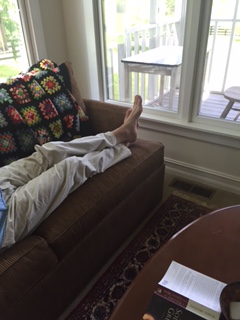
IMG_0255Ralph knows how to relax; but do I?

I recently wrote about Ralph’s good mood and said that his level of relaxation versus anxiety was the key. I wasn’t lying. Because he’s been relaxed, he has been in a great mood during the visits of both our son and our grandson and despite all the entertaining and disruption to his normal life that occurred while they were here.

There was something I didn’t mention, however, because I wasn’t aware of it until now that everyone has gone:  Keeping Ralph’s anxiety at bay has been less than relaxing for me.

The good news—I somehow lost weight in the last two weeks although I stopped exercising and started eating everything I usually avoid. The bad news—I am exhausted.

Keeping Ralph on schedule and unstressed is one thing when just the two of us are going through our set daily routine. Throw in extra people, break the routine: suddenly life gets a lot more complicated.

Not that I didn’t enjoy myself. I did because having people around to talk to and laugh with and make election jokes (kind of like funeral or Alzheimer’s jokes) with was delightful.

And not that my son and 16-year-old grandson weren’t amazing…both of them perceptive, understanding and patient.

But I still found myself smoothing things over. Making sure they were not overwhelmed by Ralph, and Ralph was not overwhelmed by them.

When my grandson told me “Oppa” was in much better shape than he’d expected, I was glad and relieved. But also, secretly, a little tiny bit miffed that I was doing my job so well that no one even noticed. (And I am not fishing for compliments here, because most of you face a ton more than I do, but I’m guessing you caregivers know what I mean.)

Well, there will be another test this coming week. Ralph has been invited to go fishing with his “fishing club,” three guys from Nashville with whom he has fished in Florida for the last fifteen years. I was originally going to drive him down, drop him off  on Monday and  pick him up from the guys on their way home Friday.

But then I realized, who was I kidding. Ralph would be increasingly anxious without me for ballast and he would end up being more responsibility than any three late-middle-aged (to put it kindly) guys could handle. So I am going too. We’ll see how I like being one of the guys.

Memory–Taking One Turn At A Time


directions.jpg

It’s a good thing I got my anger out in the last blog because the day after it posted Ralph and I spent an intensive 36 hours together on an all-work-no-play trip to Florida, and I needed all the patience I could find.

I had gone to Florida alone the week before, but Ralph came this weekend to help unload a truck’s worth of furnishings and supplies at the townhouse we’ve been renting out to vacationers since we bought it at an inflated price months before the 2008 Florida real estate crash.

Ralph wanted to do the driving initially, and I let him, although I “casually” reminded him repeatedly where to turn, where to exit, what speed to go. Of course, he doesn’t remember missing any turns on our previous car trip and I didn’t remind him. However, I did stupidly mention, as if in passing, that his sense of direction was not what it used to be. He took umbrage, declaring that he’d never been good with directions—a truth but one that doesn’t exactly address subtle but important shifts: his diminishment of confidence as a driver, his loss of what used to be ingrained routes and routines, like where the best gas station bathrooms and lunch-stops are, and more distressingly his inability to remember the basics. Why are we going there again? How long are we staying again? Isn’t there a town we usually go through?

I took over driving halfway down.Being behind the wheel was definitely more relaxing to me, and Ralph took a nap. We both arrived at the townhouse ready to work.

“This is a lot of schlepping,” he kept repeating with a certain delight—Christian Southerner with a Jewish wife, Ralph loves his Yiddish phrases—as we hauled boxes up and down three flights of stairs for hours at a time. “Why are we doing this again?”

Each time he asked, I explained that our neighbor’s pipes burst last November flooding our townhouse; that insurance covered some but not all the repairs; that we were putting our place on the market since it was newly renovated and looking its best.

Basically I kept repeating the same long dissertation about the decisions we, i.e. I, had already made. But the longer and more complete my explanation, the more anxious Ralph became and the more convoluted his questions. What again, how again, why again? That word again, so friendly and jocular on his lips, so painful in my ears.

It should have been obvious but not until we were driving away from the townhouse, did I have my embarrassingly belated epiphany: I was explaining way too much. Ralph, who used to go into the longest, most complex analysis of any plan he was making, whether to buy a new car or plant a garden or go out to dinner, cannot handle big picture plans any more.

I heard myself yammering on about where did he want to have dinner and whether he wanted it before or after we bought porch chairs, when I suddenly realized the obvious: Loss of the past is not the worst problem caused by cognitive impairment. Loss of contemplating the future is far more disruptive. Ralph becomes anxious because he cannot hang onto the amount of when-where-how-why information I keep throwing at him.

So I have stopped (well, until I backslide). Ralph doesn’t need to know all the details about what we are doing two hours from now, let alone next week. He only needs to know when I see a turn coming up so he can take it. Then, once we are around the bend, we can start looking for the next road side attraction.

Mea Culpa–Sometimes This Caregiving Spouse Gets Angry (And That’s OK)

ANGRY WOMAN.jpg

Ok, so the truth is that I have been walking around all week furious at Ralph. Is that allowed, to be angry with someone with cognitive impairment? I have a voice in my head that I’ll call White Rabbit but that I also imagine (perhaps unfairly, but if I’m going for honesty here…) represents Alzheimer’s activists who would tell me, “No you don’t have that right. You can’t expect him to be a practical helpmate. You have to support him, not the other way around. You are a selfish bitch.” (I don’t really imagine the activist saying that last bit, but White Rabbit definitely.)

Well, my answer, this morning anyway, is so what? And I think it is important to accept my real feelings. As I try to define my role in Ralph’s life going forward, it doesn’t help to sweep the uncomfortable, unpretty emotional bits under the carpet. And the fact is that some of the ways he infuriates me now are no different from the ways he infuriated me before he was diagnosed.

So why am I angry this week? The details as I try to put them in typing sound almost silly: We have a rental townhouse in Florida that was recently flooded out after the neighboring townhouse’s pipes burst. I have had to take all the responsibility for dealing with insurance and repairs. I have been doing a lot of driving 5½ hours each way for 24 hour visits. This weekend is the final push—taking all the supplies and furnishing unavailable there and setting up the place. Usually I go alone but I need Ralph’s physical help this time. And he is driving me crazy.

I understand that when he repeats questions or statements, he really cannot help it. I may get impatient but I do understand. I understand why he keeps asking why we’re taking all these things to Florida, why he can’t remember to do the basic tasks he’s been assigned, why he keeps saying we can fit everything in the back seat when we obviously can’t since it’s already full. The annoyance of our repetitive dialogue gets on my nerves but is not why I am angry (well, a teensy bit).

I am angry because his obliviousness, which I usually convince myself to accept as a symptom of Alzheimer’s, is nothing new. During most of our marriage I could not depend on him when I was overwhelmed with responsibility.

And that’s what rankles.

Because I may be Ralph’s caretaker, but I’m also his wife. I imagine the wife role will recede more than it has already—and it keeps receding as our communication becomes more limited and we share less and less except the mildest chitchat—but for now the wife in me still has stored resentments that burble up when I’m triggered into remembering all the other times I couldn’t count on him, when he was self-important and impatient with my requests for help, when he was belittling, when he was generally a jerk—and all the times he was a delight too of course, but that’s another conversation.-

Mama Bear Beats Out Wife or Caregiver This Week

mama bea

Last week, I wrote about my role as wife interacting with my role as caregiver. Since then I have been reminded that my role as mother, even to my adult children, still takes precedence.

When my kids were little, Ralph used to complain, as young fathers evidently often do, that I prioritized the kids ahead of our relationship. He was right, I definitely did. I was passionately, perhaps obsessively in love with my son and my daughter. And for better or worse, I put them first. I was no Ayelet Waldman, but then Ralph was no Michael Chabon.

Then the kids grew up, damn them, and went on their far-flung ways. (What was I thinking raising them to be adventurous and independent?) Ralph and I went into marriage counseling where we finally learned to get along. Like so many empty nesters we entered a kind of second honeymoon, growing closer, rekindling genuine affection while also, at least on my part, developing my own creative and social life. After Ralph’s MCI-Early Alzheimer’s diagnosis, the dynamic between us changed again. For the last few years, as I’ve explained probably too many times, I have been in the wife/caregiver conundrum, trying to maintain my interests while needing to focus more and more energy on Ralph.

Well, Ralph is not my focus today. Tomorrow I leave to stay with my daughter while she has a minor medical procedure. She didn’t want me there at first but needs me to babysit my granddaughter. Of course as soon as she asked, I dropped everything. I have prepared meals and a friend has offered to visit Ralph but otherwise, until I sat down just now to close the computer down, I was not even thinking about the fact that I was leaving him on his own.

And Ralph is fine about that. He wants me with our daughter as much as I want to be there, but he doesn’t want to be there himself. Not that he doesn’t care. He does, his high anxiety showing as a spike in forgetfulness and napping as well as an intense desire to stay in his comfort zone at home.

I know he’ll be fine, or okay at least.

But really my head and heart are not focused on him. For the last five days, even though the medical procedure is minor, I have reverted back to Mama Bear mode. For the moment at least Ralph is again a lesser priority in my life.

ON LABELS, ROLES AND MARRIAGE WITH ALZHEIMER’S

Labels_610_300_s_c1_center_center

There has been quite a bit of discussion lately on the blogosphere about how to label or not label people with dementia, specifically whether the word “sufferer” is verboten. I am not yet brave enough to discuss the issue in detail [although basically I’m all for not labeling, but I’m also for being free to label myself any way I want without feeling as if I’ve broken some rule], but it’s got me thinking a lot about labels in general. Not so much Ralph’s as my own.

And maybe LABEL is the wrong word. Maybe I mean ROLE.

Over the last couple of years, I have grown to think of myself more and more as Ralph’s “caregiver” and have heard myself talk (pontificate?) about what being a “Caretaker” entails. It’s such an easy catchall phrase. But now I am beginning to rethink just how I should describe myself.

During the last ten years of my mother’s life I was the primary “family caretaker” although there were always professional caretakers on hand to do the often literally dirty work. She was in my house and I was the one making decisions about her care. I was the one writing checks to those care professionals out of our joint account. I was the one informing my siblings when I sensed a problem. (I was also the one complaining about my siblings and being complained about—butt-calls and miss-directed emails kept us all more informed than we’d like on both counts.) I was the one sitting in the emergency room at least once a month toward the end.

She became less and less my mother than my responsibility, my duty.  Ironically, that was when my patience increased. The unresolved conflicts between us became irrelevant, dissolving like the thread doctors use to stitch up torn skin. At some point I stopped feeling like a daughter.

But as fraught as the mother-daughter relationship can be, the husband-wife relationship  is fraught in a whole different way–especially in a marriage with a man whose mental world is shrinking while mine is not.

Am I more wife or caregiver? As much as my marriage and relationship with Ralph have changed, despite my new sense of being the decider, I am not sure which way to answer that question.

Because he still annoys me the way only a husband can. The other day he was repeating one of his boastful but charming stories for the third or fourth time in half an hour. That immediate repetition I didn’t mind—it’s the Alzheimer’s speaking—but I have probably heard that story over a hundred times in our life together, since long before any memory loss, and frankly I’m sick of it.

And because I still use that bitchy tone I have always reserved especially for him on occasions of mild to extreme annoyance. Although the issues are smaller these days than in the past, I’ve noticed that my annoyance can be just as extreme. What’s changed is that Ralph doesn’t shout at me or storm out the way he used to. Instead with earnest sincerity, he asks me not to use that tone because it makes him feel bad. And then I have a complicated wifely reaction of guilt and resentment, based on our history and all the times we made each other feel bad.

On the other hand, I still feel the need to get his opinion and advice, on business decisions, on family matters, on what blouse to wear. Of course Ralph used to be extremely opinionated, always ready to give advice whether I was ready to receive it or not. Now he is easily swayed by what I think and really has no opinion on most matters, political, social, or sartorial.

So, yes, Ralph’s reactions to daily life and to me have changed since his diagnosis of Mild Cognitive Impairment/Early Alzheimer’s. But I am not thinking about  Ralph right now, but about me, however selfish that sounds. I am worrying how I may be changing.

I have that luxury because Ralph’s mental state is on a plateau; his memory and other symptoms have held steady for the last year. Therefore our marriage is also on a plateau, part purgatory and part second honeymoon, as we watch for signs of the deterioration everyone agrees will be coming sooner or later.

Meanwhile my emotions regarding Ralph, while tempered by my awareness of his diagnosis and prognosis, are pretty much the same as they have been since practically the day we met: a crazy quilt of guilt, contentment, resentment, protectiveness, impatience, loyalty, recalcitrance, affection, annoyance, love and occasional hate.

And my self-definition—creative independent woman, passive helpmate, head of household, housewife, caregiver, care giving wife, wife who cares for, wife who wants to escape to Tahiti—remains constantly in flux. I am the woman I’ve always been, but I’m someone else as well. That caregiver word is there, stuck in the middle, not yet in capital letters.

IMG_0130(This crazy quilt belonged to my grandmother. Note the centennial snippet.)