Tag Archives: marriage and memory loss

The Ever Changing New Normal

Eighteen months ago I was sitting in a six-week support group I had recently joined for caregivers when a new member walked in late, sat down and burst into tears in. She was a young woman in her late forties with a child in college and another in high school. Her husband was a former economics professor no longer able to teach due to his Early Onset Alzheimer’s. While she struggled to maintain her high pressure banking career to support their family, he spent his days in his home office playing chess on the computer and supposedly organizing his files. She tearfully described what a mess the office had become. She said he was depressed and angry and she was not sure how to go on.

At the time I was full of pity and secret relief. Her husband seemed so much further along the Alzheimer’s path than Ralph. Interestingly enough, her husband was the one person Ralph genuinely liked in the care-getters group which met at the same time as our care-givers group.  Ralph complained continually about having to listen to people drone on in his group, but when givers and getters came together for a luncheon when the six weeks series ended, he made a point of going up to the former professor to shake his hand and wish him well before we left.

Flash forward to the present. On my way to the grocery store this afternoon after a morning of office work, I realized that Ralph was not at home in his usual spot on the porch or out in the field mowing, but at his barn office/painting studio where he keeps a few files, his fishing equipment, and his art supplies. Ralph has always been a talented painter and always said that once he retired he would take it up more seriously. But despite my nagging, he has not lifted a paintbrush.

Still I became briefly excited.  Now that  the weather has turned cold, sitting on the porch smoking might be less appealing, so maybe Ralph was going to buckle down and begin to paint again after all.

But no. Ralph was sitting in his messy office, smoking a cigarette  with his dog at his feet.  When I walked in and asked what he was doing, he  said he was organizing his files.

Appreciating the Common Cold

This will be short because I don’t have much time to write today. Ralph is sick in bed with a very bad cold and I am playing nurse—note, I said playing and nurse, not being or caregiver.

In the old days when Ralph was sick, I always complained, at least to myself, about what a baby he was. Now I find myself offering to make him toast and tea. I make pots of homemade chicken soup. I have skipped scheduled meetings and almost cancelled a trip Ralph and I both agree I should take with my son.

Yet I feel none of the resentment I usually feel around my never-ending sense of responsibility toward Ralph.

Why? I keep asking myself until I realize that it is much easier to deal with the fact of Ralph with a concrete, physical, medical ailment. Not that the brain changes connected to Alzheimer’s are not medical or the plaque build up in his brain is not physical. But for me there is a psychological or maybe I should say magical thinking difference:

What Ralph calls his fogginess is frustrating to manage or even face because it is hard to quantify. Maybe his namenda and donepezil make a difference, maybe they don’t. Maybe I sense him losing more memory lately and being slower on the uptake or maybe I’m looking at his every sentence too closely and reading too much into his slips. I don’t know and don’t always trust my guesses.

On the other hand, a stuffed nose is a stuffed nose and a fever of 102, while serious, can be measured going up or down. The efficacy of cold medicine is uncertain but plop plop fizz fizz what a relief a cold can be. After all, we both know he will recover from it—tomorrow or the next day his nose will stop running, his fever will drop, and physically at least he’ll be “better”. His memory? Not so much.

Mourning Ralph’s Memory Loss As Well As My Mother

A friend called to offer condolences yesterday concerning my mother’s death. Having cared for her mother for several years, she reminded me that people who have not been through the experience don’t realize the amount of energy expended. Then she added, “At least you will have new energy now that you are done being a caregiver.”

Not quite. As I explained to my friend, my caregiving has just begun.

Just the day before her call Ralph and I had gone to the Memory Center at Emory for his six-month check up. Although it did feel a bit odd heading out only two days after my mother’s death, these appointments are like gold and I was not about to re-schedule.

It was a rough visit. Although Ralph did not have to take the big battery of tests this time, our NP Stephanie did one brief test, giving him a name and address that he was to remember. A few minutes later he had no clue what she had told him to remember. She offered a clue that might have tipped him off that the last name was his, but it evidently didn’t help since he made a wild guess.

This small memory failure felt more demoralizing than all the previous results we have received over the last 18 months. It was so stark: no retrieval was possible. The box where he’d stored the memory was simple empty and he knew it.

Also upsetting, although a matter of stating the obvious, was Stephanie’s warning about driving. While Stephanie reiterated that Ralph’s motor skills and problem solving are still fine, she said he should limit driving alone because she’s had “dozens” of patients at his level of cognitive ability who became dangerously disoriented when something on a usual route changed; confusion combined with anxiety caused them to drive off course, sometimes for hundreds of miles. “We don’t want to lose you,” she said gently. The truth is that I already do the driving when we’re going anywhere together these days including his last two fishing trips to Florida—actually, the time before last he drove, took a wrong term and got us lost before I used my phone GPS; I drove us down last time. We hadn’t talked about why I’m the driver though and now it was out there on the table. Stephanie agreed he could still drive himself to Atlanta for his weekly therapy appointment, but the writing is on the wall. And Ralph could read it perfectly well. He looked beaten down even as he smiled in jovial agreement.

Then there was the discussion of activities and depression. Ralph’s lack of activity worries her. She has increased his dose of anti-depressant and he reluctantly agreed to sign up for an art class and to go out with me one night a week. This was major: although Ralph, who has some genuine talent, always said he was looking forward to painting in earnest once he had some time, he has not picked up a pencil or brush for two years. I have nagged him about classes of course, but he has refused. I’m glad he has finally agreed, but his meekness was disconcerting. I know that my own emotions are on edge as I deal with my mother’s death, but I could tell that Ralph was processing Stephanie’s words differently than he has in past meetings.

As soon as we were back in the car, he turned to me and asked, “How long do you think I have?”

To live with a modicum of dignity and awareness was the unspoken second half of the question.I answered the only way I could.  “I don’t know.”

Then I drove him home and dropped him off before heading to the funeral home to pick up my mother’s ashes.

DRIVING AND PAYING

A few days ago Ralph had an appointment at the same dentist’s office he has frequented for thirty years. When I first made the appointment, I asked if he wanted me to come along. He said I should just write out the directions (he doesn’t use GPS). A lot of me wanted to agree since I don’t much like giving up the time—an hour each way plus the visit itself.

Then reality set in. After confirming the appointment a couple of days ahead, I began to worry about sending Ralph off on his own. I imagined him circling Atlanta, lost on streets that have been familiar to him for years. Fortunately, if  sadly, Ralph decided he wanted me to drive him after all. The anxiety was too much for him.

So I drove him into town and read People Magazine for an hour in the waiting room. Then I paid for the visit with my credit card and drove us home.

Driving and paying are small acts.

But they epitomize just how much our lives have already altered since Ralph’s diagnosis of MCI. Ralph, the man who spent his career as a self-proclaimed entrepreneur, no longer is comfortable or even interested in handling money. Ralph, the fix anything guy who was refurbishing and selling old telephone trucks for a living when we first met, prefers not to drive at all. And impractical, absent-minded professor type Alice, who couldn’t balance my own checkbook or change a tire to save my life and whose kids still tease me about my nervous driving, has taken over all the practical issues in our life.

Driving and Paying: changes that not only  define our daily mundane routine but  serve as metaphors for the larger, psychological and spiritual landscape we have begun to inhabit . And it is scary to examine that landscape, not only for Ralph’s future but also my own. But in my next few postings, I will try–if the daily and mundane don’t get in the way as they usually do lately.

Mood Lasts Beyond Memory for Alzheimer’s Patients

The fact that forgotten events can continue to exert a profound influence on a patient’s emotional life highlights the need for caregivers to avoid causing negative feelings and to try to induce positive feelings.

This quote comes from a University of Iowa study on mood retention among Alzheimer’s patients, results I heard discussed a few days ago on NPR. The interviewer was thrilled with the information. And I know I should be too. After all, Ralph is still in a great mood ten days after we hosted the wedding because he knows he had a wonderful time even if  he can’t remember almost any of the details.

But what I actually thought as I listened to the earnestly enthusiastic young researcher was, “Oh great, now I have another reason to feel guilty.”

What I heard her telling me was that If feelings linger after the memory fades, I am “causing negative feelings” in Ralph more often than I want to admit. I see the way his face collapses when I am short with him after he asks me where I am going for the fifth time in half an hour. Or when I get annoyed that he has forgotten to take his pills or has not given me an important message from the electrician or has gone to bed before eight after spending the entire afternoon asleep on the couch. Less than a minute ago, he interrupted me as I was typing here at my desk with another question I had just answered, and I shouted down the stairs Not Now I’m Busy in a less than kind voice. Since Ralph’s diagnosis of MCI over a year ago, I have told myself not to feel bad about outbursts of impatience because he won’t remember. Evidently I was wrong: an essential non-cognitive part of him will remember.

Coincidentally, the blogger of “Not My Original Plan” –whom  I much admire for her realistic and committed optimism–writes in her most recent post about enjoying her mother’s lingering joy after the actual memory of an experience they have shared together fades.  I know I should follow her example and be glad that in some essential way his loss of memory has not robbed Ralph of his emotional life. And most of me is glad.

But to be honest, another considerable part of me liked thinking I had an escape hatch from responsibility:  I could let down my guard and be selfish or mean or emotionally lazy without it counting as long as Ralph wouldn’t remember.  That escape hatch is closed from now on, and I can’t help letting out a short sigh of “caregiver” fatigue.

The Wedding

the wedding

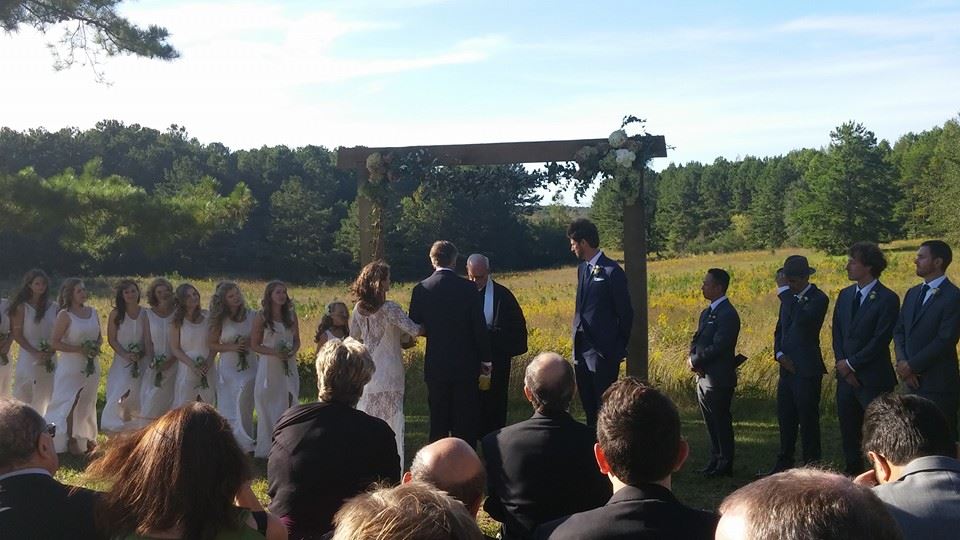
The Wedding last Saturday was…well frankly, it was perfect.

After a stormy Friday, Saturday was sunny and cool. All my daughter’s detailed planning and iron-willed determination to have everything the way she envisioned resulted in a pitch perfect experience—simple but elegant, from the burlap covered hay-bales that guests sat on for the ceremony to the candles that guests lit and floated on the pond. And the emotional intensity was overwhelming, from the way Ralph and our daughter Hilary strode (and I mean strode) down the aisle grinning to the way my daughter included and embraced her ten year-old step-daughter as an integral part of the wedding ceremony, to the tears in the groom’s eyes. Actually there wasn’t a dry eye in the pecan grove. I could go on describing the details forever (like the way Jason rowed Hilary across our pond to the reception).

As for Ralph, he was totally in his element.

For the previous week he had been a wreck, repeating his certainty that the wedding would be a disaster about once an hour and generally unable to keep anything in his head. My impatience combined with my own anxiety didn’t help matters.

Then Thursday night our sons both arrived. The guys live on opposite sides of the country and last saw each other in an airport for fifteen minutes several years ago. Ralph, who is asleep every night by 8:30, sat up with them until three in the morning. I wasn’t about to take that family time away from him, but I was a nervous wreck assuming the beer consumed coupled with exhaustion coupled with tension would leave Ralph unable to function during the important two days to come.

And Friday morning he was still incredibly anxious about the wedding; the intermittent thunderstorms all day didn’t help. But Ralph was also remarkably sharp—what did help was the arrival to the farm of the bridesmaids who paid Ralph lots of attention. (“Why do young girls flirt with me so much,” has become a new refrain, half-boastful, half genuinely curious.)

During the rehearsal, when the minister explained to Ralph that he had a line to say during the ceremony the next day, Ralph was obviously concerned that he might mess up. I was concerned too until I realized that the minister, a good friend who knows Ralph’s situation, would take care of him.

Ralph, whose sense of time gets wobbly, especially when we’re going somewhere he doesn’t want to go, complained how interminable the 30-minute drive to the rehearsal dinner seemed. I was worried. He was clearly dreading the dinner where he would have to interact with more people than he’s used to in a setting that was unfamiliar. I was selfishly dreading embarrassing interactions, afraid he would have a panic attack as he has in the past or even refuse to participate.

But when we walked through the door Ralph transformed. He didn’t have to recognize anyone because everyone knew him. He began to hold court. When the speeches began, he became so inspired that he stood up to give his own toast extemporaneously, regaling us with a story about Hilary and a friend’s escapades. No one who didn’t already know would have had a clue that Ralph has issues with memory. After we got home from the dinner, he stayed up late again with the crowd staying at the farm. Again I worried that he would not be able to function the next day.

And again I was wrong.

Saturday afternoon, when he walked our girl down the aisle, he was completely assured. When the minister asked who gave Hilary away in marriage, Ralph boomed out, “Her mother and I do.” The ceremony went without a hitch. And the reception, full of good food and dancing to a great band, was a huge success crowned by my new granddaughter’s toast, a speech she wrote all by herself that brought down the house.

Ralph had a ball.

He can’t remember any details now. He has no memory of the ceremony having happened. He doesn’t recall the dinner outside under the trees or with whom he danced (and he danced a lot). He does remember the girls paying him attention. And he wishes our sons had hung around longer. We both wonder how he’ll fill his time…but that’s another post.

Mostly he’s let down that it’s over. After months of doom and gloom that the wedding would be disaster, now he’s upset we don’t have an excuse for another party.

Because as he tells me every ten minutes, “You know, I think that went really well.”


Wedding Preparations Don’t Stop For MCI

Long before she received her engagement ring, our daughter made it clear she wanted to have her wedding  on our farm, where she and her brother grew up doing chores, riding horses and complaining that we lived in the middle of nowhere. Watching the recent cognitive changes in her father only made her more determined.

“Something simple, a simple farm wedding.”

In barely two weeks 120 guests will trek a wooded, far-from-manicured path out to a clearing within a pecan grove where they will sit on hay bales  to witness  Hilary’s wedding. Her older brother will play the bagpipes AND the sitar during the ceremony. A close friend will officiate. The groom’s ten-year-old daughter will be maid of honor. Everyone will then stroll back to the banks of our fishing pond to celebrate with  dinner, drink and a live bluegrass band under the stars (with a covered hay barn nearby just in case). We’ll eat wedding cake baked by my daughter’s best friend’s mother along with the 130 individual jelly jars of tiramisu she and I made together on Sunday.

It all sounds and hopefully will turn out to be delightful, but that “simple farm wedding” has ballooned into quite a production. While my daughter and her intended have done most of the decision-making and a lot of the organizing, the party is in our backyard—not to mention that a lot of guests will be camping out afterward and I’ll be feeding them the next day—so getting the farm ready has been Ralph and my responsibility.

Responsibility is not something Ralph likes to take on these days. His Mild Cognitive Impairment means that he can’t remember making or receiving phone calls, let alone the content of the calls. He gets anxious about dates and times. He needs 12 hours of sleep at night plus a nap in the afternoon. Nevertheless, as the wedding approaches he has stepped up and taken on extra responsibilities, just as he did this past winter while I was recovering slowly from a broken ankle.

In the last couple of months he has mowed our big pastures on his tractor, used the smaller mower at the reception and wedding sites, made the small repairs I’ve requested around the house because I am mechanically inept, and done various other chores. Given his limited mental and physical energy, he usually starts around 11am and quits by 2pm to sit on the porch until his nap before dinner. The farm, which was looking more than a little downtrodden, has spruced up in slow but steady increments. Next week he will use the tractor to smooth our ¼ mile unpaved driveway. As long as I remind him with his daily list.

I have to be careful though. Too much instruction or pressure definitely backfires. His memory blocks up. I am learning to control my natural impatience over how slowly long-term goals get accomplished and to bite my tongue when Ralph mows where he’s not supposed to instead of where I asked. Eventually he seems to follow through on every request more or less.

So although I lie awake every night worrying about where people will park, this wedding has been a boon. For a man whose attention span for reading and even television has dried up, Ralph has been remarkably focused. And he’s so good-natured about it. (Pre-cognitive impairment, he would have been super competent but grouchy.) He’s even relented and agreed to a new suit.

But there is a downside. As the day approaches, his anxiety rises. “This is going to be a disaster isn’t it?” he asks everyday, and since cognitive impairment has not impaired his fatherly ambivalence, he always adds, “Jason’s a great guy, but I don’t want my baby girl getting married at all.”

Silences

I am not going to pretend that there were never silences in our marriage before Ralph was diagnosed with Mild Cognitive Impairment. Our arguments included the silence of resentment, the silence of fury. Ralph and I argued a lot since we were frequently on different wavelengths about everything from child rearing to national politics. But when those silences happened, I was passive-aggressive while Ralph used to be the one who eventually stormed and stomped beforehand.

…..Not to diverge but I just noticed that I write Ralph used to be the one who an awful lot     in my posts:                                                                                                                                                                                  Ralph used to be the one who complained about silences.                                                                     Ralph used to be the one who followed a regimen with medicine.                                                    Ralph used to be the one who was more outgoing.                                                                                                           Used to be the one who took care of our business affairs,                                                                                          Used to be the one who was into rules and regulations,                                                                                             The one who drove too fast.                                                                                                                                                The one who was charismatic,                                                                                                                       Who loved to analyze politics,                                                                                                                        Who was good with facts and figures,                                                                                                            Who was the family disciplinarian.                                                                                                                  Who could remember everyone’s name,                                                                                                     Who was intellectually and emotionally passionate.

Now Ralph has relinquished many of his roles, every one of those listed above. Meanwhile I am taking some but not all of them up in his place: yes, I’m the one running the business, setting the schedule if not the rules, remembering whatever needs remembering, but not picking up the slack on passion or charisma.

Sometimes, especially when I receive sympathetic comments, I wonder if I am giving people a lopsided view of Ralph here. Too much Ralph used to be.

Because the fact is, Ralph still functions on a daily basis pretty damn well. He can drive a car (even if he can’t remember directions), he can go to the hardware store and discuss why the tub leaks with our plumber, he can fix complicated machinery. He can carry on a perfectly reasonable conversation, even if he doesn’t remember it afterwards. If you met him, you would probably wonder what all my fuss is about.

Sometimes I wonder myself. After all, we have not really argued in months. Sometimes I am short-tempered and speak harshly, but he doesn’t remember long enough for my behavior to matter. And he almost never expresses anger himself. It takes very little to keep him pleased: whatever I cook for dinner is delicious these days, whatever I wear looks great, whatever he reads is interesting.

If anything, he is too easily pleased. Our lives have flattened. I am ashamed  how bored I get with Ralph’s conversations about the weather and the dog, yet how disinclined I am to share my own thoughts and feelings with him—I’m embarrassed to admit that I’ve stopped trying very hard. Writing these sentences forces me to acknowledge that while I know who Ralph used to be, I am not at all sure who Ralph is now or who we are together.

I have read enough about the later stages of Alzheimer’s to realize that down the road I may well look back on these early days of Ralph’s cognitive loss with nostalgia. But right now I’m nostalgic about our imperfect past, even those churning  silences we used to share as furious but passionate equals.

What’s Up with Namenda?

Medicine is not my forte. Ralph was the one who always followed a strict regimen of vitamins and minerals. I can’t tell you how many bottles of women’s vitamins ended up half-used before I threw them out. I can’t even remember to take my calcium chews, even though they are chocolate flavored (well, a wan shadow of chocolate flavor). So I am not the best person to be in charge of someone else taking medicine. But I am now the filler of Ralph’s seven-day prescription reminder box.

Sixteen months ago, when Ralph was first diagnosed, our doctor prescribed donepezil, the generic name for the drug many newly diagnosed MCI or early Alzheimer’s patients take—the most common brand name is Aricep. No one claims donepezil cures Alzheimer’s, and the many studies on its efficacy seem inconclusive about whether it actually slows down the symptoms. But as soon as Ralph started on the drug, his symptoms stopped getting worse. And although this is not always the case for donepezil, he had no side effects.

About eight months ago, we added Namenda to Ralph’s routine. Namenda, which is the brand name for the generic memantine, complicated our schedule because it had to be taken twice a day. That second pill was hard to remember, for Ralph and me both. But again there were no side effects, and as much as he says he hates taking pills, Ralph felt the combination of Namenda, donepezil and escitalopram, brand name Lexipro—which his psychiatrist prescribed to help Ralph’s mood—was beneficial

About six months ago, a new once-a-day version of Namenda suddenly became available. Although our doctor said the drug company was manipulating the market because Namenda’s patent was running out, we were thrilled. One set of pills a day made life so much easier. I still was the one who filled the pill boxes, but Ralph became a champ at remembering to take his pills, and I got out of the habit of reminding him.

Until last week.

When I contacted our on-line pharmacy for refills, I was told there was a manufacturer’s supply problem. No renewal of once-a-day Namenda for at least a month or two, maybe longer. I called the local chain drug store; Ralph will not let me order his drugs from our independent pharmacy where the pharmacist knows him. No once-a-day Namenda was available there either but they had plenty of twice-a-day. I called the doctor’s office; the nurse said other patients had been calling with the same problem and she would check into the situation. Two days later she called back and said to go back to twice-a-day.

Bummer.

I ordered the pills, filled the boxes and told Ralph we were back to twice a day. That was Wednesday. Thursday he took all three A.M. pills but forgot the P.M.. Namenda and was asleep by the time I noticed. Yesterday, I had to leave the house early and he forgot his A.M. doses, but did take his P.M. Namenda. Today I handed him his A.M. pills with his morning coffee. And as soon as I post here, I am going downstairs to remind him, it’s time for the P.M. Namenda.

We’ll get the new/old routine down eventually but I would love to know what’s behind the sudden shortage and why we’re being held hostage by the pharmaceuticals.

My Mother’s Not Cognitively Impaired, Just Old

I spent yesterday in a rush of care-taking. Not for Ralph but for my mother. This morning while I was in Atlanta buying wine for my daughter’s wedding, the nursing home called to say my mother needed to go to a hospital emergency room because her Coumadin levels would not go down. So I rushed to the nursing home (almost an hour away), then followed the ambulance to the hospital, another forty-five more minute drive, where she was admitted to the ER.  At around 4:30, while they were running tests, I drove home to check on Ralph,  drop off the wine that was sitting in my hot car, and grab an apple since I missed lunch.

I got back to the ER in less than an hour, at 5:30 on the dot, but Mom was furious, sure I had been gone for hours.

Two hours later the doctor came by to say her levels were back to normal and her overall health looked good. So I followed another EMT vehicle back to the nursing home, stopping at Arby’s so I could pick up Mom’s favorite dinner before heading back to the farm where Ralph was already asleep.

It was a long day but throughout my mother was as alert and lively as she’s been in over a year. At 96, she is bedridden, can’t hear or see very well but has a memory more intact than Ralph’s. She does suffer bouts of confusion, seeing people who aren’t there in what I consider heightened daydreams.  I would daydream heavily too if I were as bored as she seems to be. At the ER, she was thrilled both by the attention she was receiving and all the emergency room activity going on in front her. Her major worry was  that I wasn’t home to make Ralph’s supper. So when we got the upbeat results I called him and handed her the phone so she could tell him the good news.

During the nine years my mother lived with us, she and Ralph developed more of a relationship than they’d had during the previous 24 years of my marriage during which Ralph sensed she never fully approved or accepted him. He was probably right. Still he was a good sport when my she moved in. He wasn’t thrilled at giving up our privacy (and neither was I) but I think he was a little proud of being the only one strong enough to get her up—she is not a small woman—when she fell as she did more and more frequently toward the end of her stay.

I decided last fall that she needed to go into a nursing facility, in part because she was requiring more care than we could offer at home even with full-time caregivers, but also because Ralph had been diagnosed by then and I wasn’t sure what he was going to need from me. (Of course, I didn’t mention that reason to Ralph or even fully articulate it to myself.) At first Ralph was all for the move but as it approached, he began to question my decision. It was as if he were beginning to identify with her. Still, in the end, after a particularly scary event involving a 911 call,  everyone in the family agreed that she had to be moved.

Ralph and my mother have not  seen each other since she entered the nursing home. And they won’t see each other as long as she’s there, in other words for the rest of her life. He does not need to smell the hallways and see the patients lolling sideways in wheel chairs, talking to themselves,  staring into space or grabbing at everyone who passes. He does not  need to peek into the half-lit rooms like the one where my mother lies dozing most of the day. His unspoken fears about his future are strong enough.

As Ralph puts it, “it’s too depressing.”

Still, he asks me daily if she seems happy, and I always answer yes, she does.