
Tag Archives: marriage and memory loss

Money on the Mind

IMG_0190.JPG

Sex and Money. The two topics that generate curiosity but can be pretty uncomfortable to discuss in general, and in regard to Alzheimer’s especially. I admit I am not ready to talk about sex, but money? I’m not sure, but because I’m in the middle of doing taxes, money is on my mind.

How much do we have? Enough. We are lucky. (Around the time Ralph was diagnosed he decided to “retire” from his business managing rental property, much of which we owned. We—meaning I–sold most but not all of the property to create a nest egg while we live day to day off the reduced income from the rental property we still own.)

How much do we need?Frankly our needs are much less on a daily basis. We seldom eat out and we are not buying “stuff” any more. Our medical costs, including Ralph’s medicines for most of the year, are pretty much taken care of by Medicare and our supplemental insurance. Lately I have shelled out for some costly business expenses, emergency building repairs, that have eaten into our income and that’s been a little scary—a hint of how things could change on a dime.

What are the money issues to come?  Housing and medical care. I have written before about the value of long term care insurance. We fortunately purchased it before Ralph’s diagnosis. I am hoping that if/when Ralph’s condition requires outside care, the insurance will kick in. But I worry that the glut of baby-boomer like us may bankrupt the long-care insurance companies before I need help so I am storing away funds just in case.                                                                                                        And then there is housing. Despite Ralph’s current conviction that he will never leave, at some point the farm is not going to be viable, and I will have to decide when, not to mention where we go from here. Will we be able to sell or rent out the farm for enough to afford our next living situation(s)? I don’t know but frankly I am not ready to think about myself yet.

How well am I making financial decisions, alone, concerning our future?  The truth is that I tend to go for easy decisions. And there are decisions—about whether to spend money on a given repair, how to keep our savings safe without losing ground, how to plan for our future needs. Ralph used to discuss these topics endlessly and we still discuss them, but he doesn’t remember from conversation to conversation what we last decided. I try to think what Ralph would do, but then I also remember that I did not always agree with what Ralph did when he was in charge. (I resent the money we are still shelling out to support bad decisions Ralph made about ten years ago—around when his cognitive loss probably began.)                                                                                                                                                        The real answer here is that at my accountant’s suggestion, I turned to a fee-based financial planner who advises me holistically and is available whenever I call with a question on the smallest issue. In some ways that financial relationship is more intimate than any other.

Post Script:

Before I posted this I had to run an errand. On the way home I stopped at Starbucks where man in line behind me was acting a bit confused in a way I recognized; when his wife explained that he had Alzheimer’s, I said so did mine. We began talking like long-lost friends (we use the same doctor and support system at Emory and are at similar points in the progression). One of the things she discussed the unmanageable cost of  sending her husband to a day program while she was at her job.                                                                      When I got home  I found a response to my earlier post about driving and Alzheimer’s: A woman, who doesn’t drive herself, has realized her husband can no longer driver due to Alzheimer’s. How is she going to solve that situation? Public transportation? Taxis? Uber?       I am suddenly struck anew by the financial realities that Alzheimer’s poses for so many and by the need for our support systems to come to grips with the needs presented. I realize I need to contact our local Alzheimer’s Association to see what services are offered and to volunteer to solve the problem of gaps between needs and financial cost—not where I expected writing about money to take me but it has…..


Alzheimer’s and Politics: Ralph’s Non-Vote

IMG_0157.JPG


Well I just got back from voting. Super Tuesday. A big deal.

I live in a voting district so politically lopsided that only candidates from one party (and not mine) run for national and state office. Usually my vote is so irrelevant that I have been known to write in “Anyone But…” on more than one occasion. So, as depressing as this political season has been, I felt a little twinge of excitement knowing that for a change my vote will actually matter.

I asked Ralph if he’d like to vote. After all, he listens to Public Radio every morning and watches the news every night. At various times he has declared Candidate X is definitely his candidate, or sometimes Candidate Y until I remind him he is for Candidate X (whom I am backing). He has laughed at stupid campaign ads and made astute comments about various candidates’ stupid statements. He has always voted.

Ralph said no, he didn’t feel like voting today. Then he asked what the issue was. I said the presidential primary. He still wasn’t interested.

His answer depressed me incredibly. In so many ways politics has defined our relationship from the start and now it is defining us in a different way.

When we met in the early 1970s, as the Nixon presidency and the Vietnam War were both unraveling, our romance centered on our shared political values. Or rather me sharing Ralph’s. We worked in the alternative press, and Ralph was passionate about his views. I remember sitting beside him on a couch as he went on and on about some theory or other while all I wanted was for him to shut up and kiss me.

Cut to the 1980s. Married with kids, and arguing a lot—a lot!!—mostly about decision-making; I found him controlling and he found me unsupportive. What we did not argue about was politics. We were both part of the small minority that voted for John Anderson in 1980 (although I had to look on the Internet just now to remember his name) and we both thought Reagan was not all there (little did we know, ironically enough). Our political agreement was important; I told myself that I could never be married to someone if I didn’t share his political beliefs

In the 1990s came the big shift. We moved to the country (another big argument that lasted for years) and midway through Clinton’s second term Ralph began to call himself a libertarian. “I’m not a Republican. I am Libertarian,” became his mantra. He was as passionate as a Libertarian as he had been when he was a socialist. I did not become a Libertarian, however, and was no longer susceptible to being swayed by any man.

In the first year of the new century, politics turned out to be a wonderful vehicle for arguments. We couldn’t watch the news together without fireworks, and the family dinner table became the set for great shouting matches, as our kids will attest. We railed against each other about taxes and the Mideast (although we still agreed on most social issues). Of course, under the political veneer our arguments were often about unspoken personal grudges and resentments we each nursed.

And now here we are in the most heated political atmosphere imaginable, and Ralph has gone lukewarm. He wants to be interested I think because he asks me frequently, “Who’s running again?” He cannot keep any of the candidates straight, although that may have more to do their deficiencies than with any cognitive deficiency on Ralph’s part.

The thing is, he would have voted today for whomever I suggested. While he listens to the news nonstop, very little of it sticks with him. This is not only a matter of memory. In part, his attention is turned more inward, but also he has a certainly mental hesitancy as if he doesn’t trust his own instincts. As a result I can easily convince him to agree with me, not only about the candidates, but also about any analysis of world events.

He now listens to me rail the way I used to listen when he railed. I admit I don’t mind being having an enthralled audience of one. I like being agreed with. I like being the one spouting righteous certainties. But this strange reversal is more bitter than sweet.

Driving and Alzheimer’s

driving_268131086


Memo to myself when I look back in years hence:

So six months ago our PA Stephanie asked Ralph how much driving he did alone. And he told her: the convenience store five minutes down the road; the Spanish grocery ten minutes away where our handyman likes Ralph to drive him to cash his checks; and Ralph’s therapist in Atlanta.

Since his diagnosis that weekly trip to the therapist has been Ralph’s big expression of independence and competence. He has his route down pat. He stops at the post office and checks to check our box; he takes a load of garbage to the dumpster at our old office; he picks up lunch at Burger King; he visits his therapist; he drives home.

Stephanie took notes, then warned us both to keep an eye on Ralph’s driving. Not so much his skill set but his sense of direction. She explained that a new detour can really be confusing for a driver with cognitive impairment and that the anxiety can made the driver too confused to find his way back on track.

When she suggested I start driving him to Atlanta, at least occasionally to make sure it was safe, Ralph and I immediately took umbrage…Ralph because driving is part of his sense of his identity as a competent man, me because I didn’t look forward to giving up a whole day every week to drive him back and forth. But the next week I made some excuse to ride with him into town—he was not about to accept that I needed to drive him—to make sure I was not just being selfish. As I reported to Stephanie on our next visit, Ralph seemed fine. In fact, he seemed to be a better driver, more cautious and careful.

Jump ahead to this past weekend. We drove together to the small Florida fishing town where Ralph was meeting his long-time fishing buddy.

Although I wasn’t comfortable enough with him driving five and half hours that I didn’t come along, I was pretty comfortable with him as driver since Ralph knows the way like the back of his hand. So on the way down I was happily drinking my coffee and relaxing beside him as passenger. Then I looked down to read a text, and when I looked up I realized Ralph had missed the turn. A major turn from one big highway to the next. A well marked turn that is hard to miss. We went an exit or two and turned around. I was a little tense and probably showed it more than I should have. Ralph was more than a little tense, but as I told him repeatedly in the next few hours, these things happen.

We got to Florida. Ralph calmed down and actually enjoyed himself more than either of us expected, thanks to a fishing buddy who is amazingly understanding about Ralph’s conversational loops.

Today we drove home. Ralph insisted that he wanted to drive. I was in the passenger but on alert when my phone rang. I looked down to find it, and when I looked up Ralph had missed the turn we needed to take. The turn he has taken hundreds of times. I stayed calmer this time, brushed the mistake off, said we didn’t need to turn back, that this way might actually be a short cut. But he was truly rattled. For the rest of the trip we had to discuss road numbers and I had to reassure him we were on the correct road.

Twice in four days may be a sign. Next week, I am driving with Ralph to Atlanta.

ON LABELS, ROLES AND MARRIAGE WITH ALZHEIMER’S

Labels_610_300_s_c1_center_center

There has been quite a bit of discussion lately on the blogosphere about how to label or not label people with dementia, specifically whether the word “sufferer” is verboten. I am not yet brave enough to discuss the issue in detail [although basically I’m all for not labeling, but I’m also for being free to label myself any way I want without feeling as if I’ve broken some rule], but it’s got me thinking a lot about labels in general. Not so much Ralph’s as my own.

And maybe LABEL is the wrong word. Maybe I mean ROLE.

Over the last couple of years, I have grown to think of myself more and more as Ralph’s “caregiver” and have heard myself talk (pontificate?) about what being a “Caretaker” entails. It’s such an easy catchall phrase. But now I am beginning to rethink just how I should describe myself.

During the last ten years of my mother’s life I was the primary “family caretaker” although there were always professional caretakers on hand to do the often literally dirty work. She was in my house and I was the one making decisions about her care. I was the one writing checks to those care professionals out of our joint account. I was the one informing my siblings when I sensed a problem. (I was also the one complaining about my siblings and being complained about—butt-calls and miss-directed emails kept us all more informed than we’d like on both counts.) I was the one sitting in the emergency room at least once a month toward the end.

She became less and less my mother than my responsibility, my duty.  Ironically, that was when my patience increased. The unresolved conflicts between us became irrelevant, dissolving like the thread doctors use to stitch up torn skin. At some point I stopped feeling like a daughter.

But as fraught as the mother-daughter relationship can be, the husband-wife relationship  is fraught in a whole different way–especially in a marriage with a man whose mental world is shrinking while mine is not.

Am I more wife or caregiver? As much as my marriage and relationship with Ralph have changed, despite my new sense of being the decider, I am not sure which way to answer that question.

Because he still annoys me the way only a husband can. The other day he was repeating one of his boastful but charming stories for the third or fourth time in half an hour. That immediate repetition I didn’t mind—it’s the Alzheimer’s speaking—but I have probably heard that story over a hundred times in our life together, since long before any memory loss, and frankly I’m sick of it.

And because I still use that bitchy tone I have always reserved especially for him on occasions of mild to extreme annoyance. Although the issues are smaller these days than in the past, I’ve noticed that my annoyance can be just as extreme. What’s changed is that Ralph doesn’t shout at me or storm out the way he used to. Instead with earnest sincerity, he asks me not to use that tone because it makes him feel bad. And then I have a complicated wifely reaction of guilt and resentment, based on our history and all the times we made each other feel bad.

On the other hand, I still feel the need to get his opinion and advice, on business decisions, on family matters, on what blouse to wear. Of course Ralph used to be extremely opinionated, always ready to give advice whether I was ready to receive it or not. Now he is easily swayed by what I think and really has no opinion on most matters, political, social, or sartorial.

So, yes, Ralph’s reactions to daily life and to me have changed since his diagnosis of Mild Cognitive Impairment/Early Alzheimer’s. But I am not thinking about  Ralph right now, but about me, however selfish that sounds. I am worrying how I may be changing.

I have that luxury because Ralph’s mental state is on a plateau; his memory and other symptoms have held steady for the last year. Therefore our marriage is also on a plateau, part purgatory and part second honeymoon, as we watch for signs of the deterioration everyone agrees will be coming sooner or later.

Meanwhile my emotions regarding Ralph, while tempered by my awareness of his diagnosis and prognosis, are pretty much the same as they have been since practically the day we met: a crazy quilt of guilt, contentment, resentment, protectiveness, impatience, loyalty, recalcitrance, affection, annoyance, love and occasional hate.

And my self-definition—creative independent woman, passive helpmate, head of household, housewife, caregiver, care giving wife, wife who cares for, wife who wants to escape to Tahiti—remains constantly in flux. I am the woman I’ve always been, but I’m someone else as well. That caregiver word is there, stuck in the middle, not yet in capital letters.

IMG_0130(This crazy quilt belonged to my grandmother. Note the centennial snippet.)
A Sunday Snapshot

Unknown

It is important to remember today. Not because anything particular happened, but because nothing particular happened.

We woke and drank coffee. Then while I worked in my office, Ralph read. For a while he had stopped reading, and I assumed books, like movies, had become too hard for him to follow. But I seem to have been wrong. Today he picked up Leonardo’s Brain, by Leonard Shlain, about Da Vinci’s genius–not exactly a light romp or what I would suggest to a reader who has trouble remembering a joke by the time he hears the punch line. Ralph is finding the book “fascinating”.

We had lunch and he read some more while I walked with a friend. Now he has gone for a “walk” with the dogs—they walk while he drives beside them in the truck. Soon we’ll have dinner and watch Sunday television.

So, a normal Sunday. Except Ralph’s conversation is sharper today, his attention more focused.

I know better than to believe that Ralph is suddenly “ getting better.” But it feels important to appreciate this moment of respite: A reason to rejoice that while the thread/threat of memory loss has woven itself into the fabric of our lives, it has not yet pulled the warp and woof askew.

Travels With Ralph

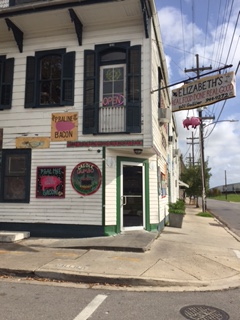
nola


This week was an adventure. Like all adventures, it offered highs and lows, memories I want to savor and some I’d rather forget.

Thanksgiving in New Orleans, with my daughter who lives here and with my son who met us there, was our first trip together, and Ralph’s first time away from the farm, in probably two years.

The last trip was to New York City for a wedding. He had no interest in making that experience into an actual vacation. He attended the official events, but otherwise I could not interest him in leaving the hotel even for a short walk around the neighborhood. All he wanted to do was nap. At the time I didn’t understand how much he needed those naps so I spent the two and half days in a general state of mild annoyance.

So, while I was thrilled at spending four days with my kids in a way we seldom do, and in a way we may not get to again, I approached this week with trepidation. As did Ralph. For the last month, each time he tried to remember the plan, I tried not worry if this much travel demanded more than he was capable of handling. Four days away from his familiar routine is a lot to ask.

On our trip to NY, the greatest stress for Ralph had been the actual travel—not only the time in the air but the airport with its crowds, its lines to maneuver and all the possibilities it offered Ralph to get confused or, worse, lost—our drive to Nola was actually pretty easy. For the six hours plus, I drove while he smoked and asked me questions over and over. We listened to the radio. It was actually kind of relaxing for both of us.

And he loved our small funky hotel in a converted mansion with its side garden where he could smoke….you might notice that smoking and Ralph’s ability to smoke has become a theme not only on this trip but in our life together.

These days I accept Ralph’s need for sleep and on this trip I made sure there was plenty of naptime. If anything, I let him sleep more than I do at home.

He needed to be as rested as possible because he was expected to take part in all activities with the kids. We ate great meals, we went for beignets, we walked along the river and down Magazine Street. We waited in line at Preservation Jazz Hall, where Ralph loved the music even though he had to stand the whole time. He loved laughing over jambalaya and drinks afterwards even more, loved walking through Jackson Square singing “The Battle of New Orleans” with my son-in-law as they vied to see who knew more of the words (a tie).

We spent Thanksgiving Day preparing a big meal at my daughter’s apartment listening to music, teasing, laughing, having the usual family spats and just hanging out together. Telling family stories Ralph was in his element, more the Ralph of years past than he has been in ages.

The description above is how I want to remember the week. But a shadow of tension followed me everywhere. “What’s the agenda?” he would ask and then ask again—questions I am used to answering over and over but my kids are not. At meals, I would suddenly realize that Ralph either wasn’t paying attention or had given up trying to follow the conversation the rest of us were having. Every time he needed to use the restroom in a restaurant I went on alert to make sure he could find his way there and back. He couldn’t follow the TV shows we sat around watching. Every few minutes he wondered aloud, “I wonder what the dogs are doing.” He went outside to smoke and went outside to smoke and went outside to smoke.

The good times, and they were good times, were a lot of emotional work for both us. I realized how much I have not only arranged my life around Ralph’s but how Ralph’s cognitive issues have played into my own tendencies toward over-planning and over-worrying, not only about him but about most areas of my life. What is most worrying is that I see how my own boundaries have narrowed, that I have to work doubly hard to keep myself engaged with the world beyond the parameters of Ralph’s MCI/Alzheimer’s.

Ten minutes ago Ralph climbed into the backseat of my car, headed back to the farm with my daughter and her husband who will fly off tomorrow on a vacation abroad (another anxiety producer given recent world events). I have stayed here in New Orleans to babysit my granddaughter for a week.

I know Ralph will be fine. He has been alone before, my son is going to stay on the farm with him a good part of the time, and various friends will be checking in regularly. His drugs are all marked, his calendar is filled in, there’s a week’s worth of meals ready, and I’m a phone call away.

But I am also a nervous wreck. Of course, maybe that has less to do with Ralph and more to do with taking charge of an 11-year-old girl who is a lot less easy to boss around than Ralph.

The Larry David Cure for Dementia

LARRY david

It was just turning 8:30 pm. As usual, Ralph was already in bed with the lights out. He goes to bed by eight most nights and will sleep past eight in the morning if I let him. He is genuinely tired, but I also suspect that he doesn’t know how else to fill the time. Neither books nor television hold his interest for very long. Neither does music or the kind lengthy conversation he used to be famous for.

I was in another room half reading the newspaper, flipping TV channels, thinking a little guiltily about a recent comment from Going Gently into That Good Night about the way those with dementia suffer.

Mostly, though. I was feeling sorry for myself over having another long night alone—no need to remember that in my thirties and forties, a night to myself without family would have seemed a gift; that’s another story. Suddenly I stopped clicking.

Because there on some random cable channel was The Larry David Show. Actually an hour and half of Larry David episodes was listed on the schedule. I rushed into the bedroom and turned on our set in front of our bed.

Ralph grumbled when I woke him, but he sat up. After all,

“I am nothing like Larry David,” Ralph said when I reminded him how the kids used to tease him that he was Larry’s spiritual twin,  (Of course they teased me that I was the spiritual twin of George’s mother on Seinfeld) but soon he was sucked in. Ralph began to chuckle. I began to chuckle. Sometimes I had to explain a character who had been introduced earlier, but Ralph had no trouble following the complexity of the wit. We laughed out loud at the same jokes.

The three episodes flew by. It was ten o’clock and Larry was over. Some lame movie started, but  I wasn’t  ready to go to sleep. Miraculously, neither was Ralph.

I switched channels. Another miracle: there was Seinfeld.

seinfeld

And one of the classic episodes. Jerry’s car is stolen by his mechanic; Newman and Kramer try to make their fortune with a mail truck full of recyclables; and George, after being sent briefly to a mental hospital, can’t get a tune from Les Miz out of his head.

“This was fun, wasn’t it,” I asked and Ralph agreed. As he rolled over to sleep, I turned off the television plotting what other comedies we might watch.

Then I tried to sleep, but George’s damn song was in my head.

“Master of the house,” I sang softly.

Ralph hooted. I repeated the line. Soon we were whooping it up like five-year-olds.

God it felt nice. I honestly cannot remember when we last shared such a genuinely good time. No soft-pedaling or covering for memory lapses, no manipulating behavior, no compromising my needs for his, no resenting the limitations of our life.

Just Ralph and me laughing away on the same joyful wavelength.

18 Months Post Diagnosis of MCI–Where Are We in Memoryland?

rings

I just realized that I began blogging about Ralph and me in April of 2014. Is that only a year and a half ago? It feels much longer, as if Ralph and I have gone through years and years of changes in the last 18 months. At the same time it feels as if the two of us are stuck and not moving forward at all.

FEELS is the operative word. Feelings are subject. Feelings can’t be trusted.

A lot of things happened—deaths, weddings, children moving away, friendships evolving, business crises. The accumulation of events big and small that form our lives. But how much as really changed in terms of Ralph and me. Have we moved deeper into Memoryland.

To gain perspective I went back to my first post to compare and contrast the salient points:

RALPH’S DIAGNOSIS:

Then: He “does not yet have the disease called Alzheimer’s. He has the CONDITION called MCI.”

Now: Still true as of his last test results at the Emory Memory Center

WHAT HE REMEMBERS:

Then: Impersonal facts like those on Jeopardy, His Meds, His Daily Routine, How to Drive

Now: He watches Jeopardy but not so much. He still retains facts, but not quite as many. He still can take his meds from his weekly box. His daily routine looks about the same on the surface although his actual day has shrunk. It is hard for him to get moving before 10 am or stay up past 8 pm. And he does a lot more sitting

WHAT HE FORGETS:

Then: Who people are. Conversations. Memories, especially bad memories…

Now: Fewer conversations are retained. More people and also facts seem lost. Old memories too.

WHO HE IS:

Then: “Sweeter than he used to be; less aggressive; more patient; less easily bored (because he doesn’t remember the twenty minutes of waiting for the doctor once it’s over); more in the moment.

But also less ambitious; less energetic; less adventurous; more passive; more dependent…Passionate about his farm and his dog…able to fix anything with his hands…a voracious reader.”

Now: Here is where the changes start. His personality is if anything even sweeter, even less aggressive. He no longer has an interest in analyzing numbers, facts and human nature. He may still be able to fix things with his hands but he doesn’t have much interest. Changing a light bulb becomes a major occasion, not because he can’t but because “it is so much trouble.” There has been a shift. A subtle withdrawal from the world we share that cannot be measured by memory tests.

OUR RELATIONSHIP:

Then: Eighteen months ago, I wrote, “although I’ve been warned there’s no telling how long before MCI begins chipping more deeply into his identity, Ralph is still himself in the most important ways.”

Now: I don’t know if I can honestly make that statement today. According to tests and my own comparison, Ralph is still functioning adequately with my support, but I have more trouble recognizing the man I married. There is a vacancy, a growing disconnect, that I sense but can’t measure.

Perhaps the greater change is not in Ralph at all, but in me. The relief I felt at first when we finally received a clear diagnosis for Ralph’s cognitive changes has shifted to something between acceptance and resignation. The support he requires weighs heavier.

We get along well on a day-to-day basis We still laugh together, usually in the mornings when he is sharpest, but we have less and less serious conversation either about the world around us or about ourselves. Sometimes, in a burst of ebullience, he’ll declare how much he loves me. And I love him, but the love is different and not exactly ebullient.

18 months ago I was a spouse learning with my husband to deal with his cognitive condition. Now I am not sure how to describe our relationship. I often feel more parental than wifely. But saying so feels (that word FEEL again) inaccurate and unfair. Because whatever we have become to each other and whatever we are becoming together and individually changes every day.

2 ALZHEIMER’S QUESTIONS NO ONE CAN ANSWER

DOES HE KNOW?    IS HE HAPPY?

These are the two questions people ask more than any others once they learn that Ralph is suffering cognitive loss due to Alzheimer’s.

Both questions should be easy to answer:    YES or NO.      Yet I can’t answer either for sure.

1. DOES HE KNOW?

What Ralph knows and what he acknowledges may or may not be the same thing.

He’ll be catching up with an old friend on the phone and I’ll hear him say, “I have a memory problem,” as if it’s just another inconvenience of aging like someone else’s arthritis.

I’ll show my annoyance about something he forgot to do, like feed the dog, and he’ll rightfully if self-righteously chastise me, “You know I have a memory problem.” Of course I immediately backtrack. (Not easy for an inveterate  nag).

But if the word Alzheimer’s comes up in general conversation, or more often in the media, he chooses to disassociate himself. There’s a TV commercial for Namenda that particularly bothers him because he  takes Namenda. He does not want to identify with the sweet old man on the screen. “I don’t have Alzheimer’s,” he’ll announce. “The doctor said I don’t have Alzheimer’s.”

Often I just nod. After all, his most recent cognitive tests show he is holding onto the smudged borderline between Alzheimer’s and Mild Cognitive Impairment. But if I slip and remind him, “The doctor explained what it means that you have the plaque build up associated with Alzheimer’s,” he’ll go very quiet.

And if I ask him pointblank how he thinks he’s doing, whether he senses any changes in his cognitive abilities (changes I do sense but don’t bring up), he says no, he’s fine. If I mention  a specific cognitive lapse, he denies it.

I understand:   He wants to be in control.

2.  IS HE HAPPY?

 He SEEMS to be, at least as happy as he’s ever been:

He laughs more. He’s less impatient. He loves his dogs. He loves his nutty buddy ice cream cones for dessert after dinner, which he also usually loves (without the critiques of my cooking he used to make). He loves his cigarettes and his lite beer. He loves sitting on the porch. He loves his farm. He says he loves fishing although he doesn’t often make the effort to fish anymore. He loves me, as he’s told me more times in the last six months than he ever did in the previous 40 years we’ve been a couple.

But what he’s thinking and feeling inside I don’t know. For a man who loved to talk politics and philosophy all night, he’s gone awfully silent.

And really, if you ask whether he was particularly happy before his memory began slipping, the answer would also be I don’t know. He’s always been moody, though less so now. And like many men of his generation, he’s never been big on revealing or analyzing himself.

Still, I can’t help wondering if boredom is the reason he sleeps so much now that he’s not interested in what’s going on in the world–or if not boredom, a desire to escape from thinking about his situation. He doesn’t voice the fears he must have about his future, and I don’t push him (well, a little) or ask point-blank if he is happy. I don’t want him to ask me back.

I am not sure how I would answer…

Alzheimer’s and The Downsizing Decision, So Far Deferred

Driving to the recycling center the other night, I was listening to NPR when a story came on about a man with Early Alzheimer’s. Naturally my ears perked up.

Journalist Greg O’Brien has been chronicling his advancing Alzheimer’s in a series of reports called Inside Alzheimer’s. For those facing their own or a loved one’s Alzheimer’s, especially in the early stages, this series from NPR is worth checking out. A range of subjects are covered from telling the kids to hallucinations, to caregiver anger. Not all the topics may be relevant to your situation but you’re bound to find one that connects.

For me it was definitely the piece the other night. Greg and his wife have decided together that it is time to sell their home on Cape Cod and downsize before his condition deteriorates. Greg talked about packing up with the help of his kids and about the pleasure of finding mementos that vividly brought back to life the family’s past.

As Greg talked, I knew Ralph was sitting at home on the porch listening to NPR and I worried how the story would affect him, wondered if he would compare himself to Greg. Because frankly I was comparing them—the same way I compare Ralph to all of my on-line friends who write such articulate blogs about the early stages of Alzheimer’s.

You are all so strong, so wise, so likable in describing your struggles.

I admit, I can’t help what I know is an unfair thought process: wishing Ralph could be more like you and push himself to live life to the fullest. Of course, I know that I am being unfair. It is as if I am asking Ralph to get over this cognitive glitch, as if he it’s his choice, so he can start remembering and I don’t have to be so responsible.

Greg’s involvement in deciding to sell his home was really hit me because I really don’t know how I am going to get Ralph to leave our farm. And the time is approaching. I spent the morning looking at real estate. I am thinking of moving us, at least part-time to New Orleans where my daughter and her new family have relocated so we can share childcare with Ralphcare.

Ralph knows this, sort of. Sometimes he can analyze the pluses and minuses with helpful perception. Sometimes he thinks spending time down there is a great idea. Sometimes he looks at me as if this new idea, which he is sure I’m presenting for the first time, is nuts.

This possible move of ours is the biggest  financial, emotional and logistical decision I have had to make since Ralph was diagnosed with MCI/Early Alzheimer’s. It affects both of us.

[I would love to hear how those of you in similar situations have decided when a change in housing is necessary–whether it’s been a matter of downsizing, moving into special housing, or even living apart–and how you handled the decision-making.]

Personally, this is the kind of decision I used to let Ralph make. I would offer my advice, would influence his thinking; but for all my feminist posturing, I preferred the more passive role—that way when things went wrong I didn’t have to take the blame.

Well those days are over. Women taking responsibility for our lives is great in theory, and probably in practice–I will explore the definite advantages of feeling empowered in another post soon. Right now I can’t remember what they are. All I am feeling is that I have no choice but to take on the power of decision-making for the two of us, and after a lifetime of back-and-forth compromise (mostly my compromise that I often resented), holding that power can be scary and lonely.