Ralph’s Famous Adventure in Hog Killing —or Keeping the Stories Alive Despite Alzheimer’s

shutterstock_275552708

I was making dinner the other night when Ralph called me out to the porch where he was having his daily late afternoon cigarette and beer listening to the radio. A story on All Things Considered had piqued a memory from his childhood.

“Have I ever told you about the hog killing?” he asked.

Oh God, not the hog killing story again, I thought as he launched into it. How many times over the years have our kids and I have heard this story–how he was a little kid visiting relatives on a farm with his family one fall during hog killing season, how his easily hysterical mother started shrieking, how the gory killing is mixed into a memory of getting ice cream cones. But it’s a better story in his telling than mine.

“You know you should write that story down,” I told him. “All your stories, actually.”

He nodded. “Yes, I should.”

This conversation is not a new conversation. Every few weeks we agree he has a lot of great stories, and is (or was) a natural storyteller of the Southern charm variety. I suggest he get a notebook and write the stories down. He says, yes, he definitely will do that.

But given Ralph’s inertia fed by his place on the Alzheimer’s spectrum, that’s only going to happen if I make it.

And so far I have been a slacker. I tell him and myself I will get a notebook and set aside time each day for us to work on stories, but then I let the whole idea slip off my radar as quickly as it slips from his. His excuse is cognitive impairment. Mine is laziness at making one more effort. The discipline it will take for me to get him to get the stories down is the same discipline I need—and have so far lacked—to get him to exercise more. His lack of enthusiasm gets me off the hook and feeds my own penchant for lethargy.

But I am making early New Year resolutions. I need to get Ralph walking before he puts on more (not to mention my inches and pounds). More important, I cannot wait until Ralph and I are both inspired to record, whether on audio or in writing, his stories.

Because otherwise the day will come when I ask him to tell me one or he tries to remember, and the story is gone.
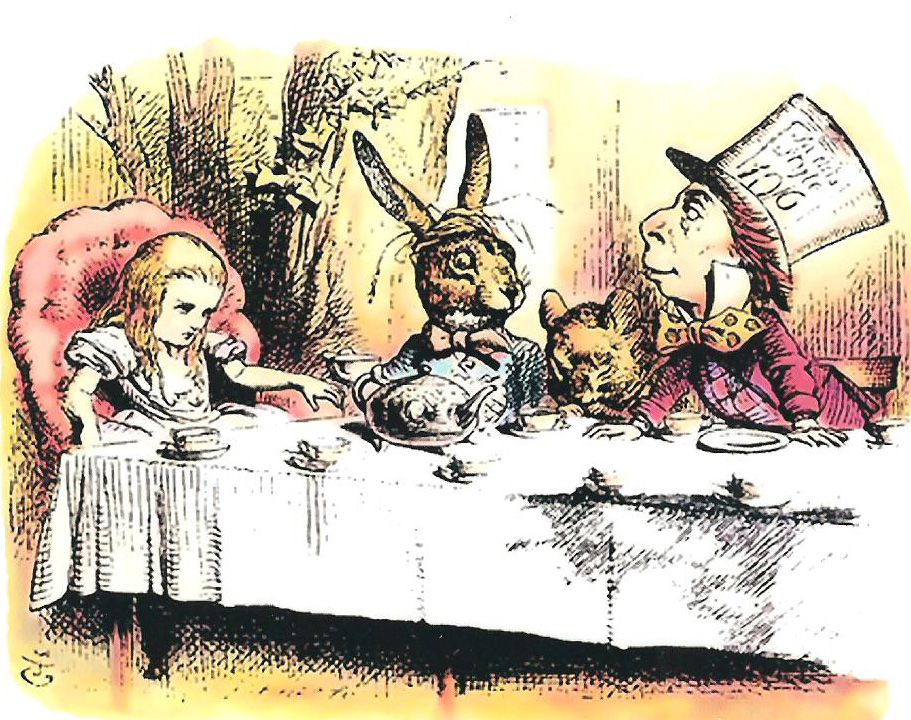
Alice Has a Pity Party

Mad-Hatter-Tea-Party

When friends compliment me for being patient and nurturing toward Ralph I have to laugh. Empathy for others easy, empathy for Ralph not so much.

Especially today. Maybe I can blame the bad cold I’ve come down with, but I feel like griping. I don’t blame you if you don’t feel like sharing my self-pity party, and if that’s the case, you might want to stop reading now.

I just spent the morning re-ordering his meds, which never arrived last week. I ordered refills weeks ago and have assumed they were on the way but when I went to feel his weekly box, I realized they still haven’t come and we are getting dangerously low. Evidently Ralph removed the post office’s post-it note without telling me I needed to pick up a package. The package got returned, we’re down to less than a week of some meds and I was on the phone with the mail order pharmacy working out how to get his meds for half an hour. In the old days, I would have yelled at Ralph for forgetting to tell me because he wasn’t paying attention, but how can I now, knowing it’s not his fault.

Then I re-organized the clothes in Ralph’s closet yet again. One of the more recent hints of slippage has been sartorial. He was never a snazzy dresser, but he was vain about his admittedly good looks. Now whatever is closest at hand is what he puts on. I no longer bother reminding him about the separation between work and dress clothes, but I do try to steer him in the right direction, mostly by having fewer choices visibly available.

Then I dug out a few Natty Lites from my secret hiding place and put them in the fridge for later this afternoon. Ralph more or less accepts this system for limiting his daily alcohol consumption although he’s remarkably able to find my hiding places, his memory and sense of direction still acute where beer and cigarettes are concerned.

This is all so trivial, and I know others’ problems concerning Alzheimer’s, not to mention poverty, hunger, war, are much worse. But I have noticed that managing these silly daily tasks with their subtle reminder of something amiss, something out of balance, sometimes drains more energy and patience  than dealing with Ralph himself. Or that after taking responsibility for the practical details of Ralph’s life, my patience for dealing with the man himself is compromised.

But as I said, I have a cold.

So I’m off to make myself tea and toast and pretend I have someone to take care of me for a little while.tea

The Larry David Cure for Dementia

LARRY david

It was just turning 8:30 pm. As usual, Ralph was already in bed with the lights out. He goes to bed by eight most nights and will sleep past eight in the morning if I let him. He is genuinely tired, but I also suspect that he doesn’t know how else to fill the time. Neither books nor television hold his interest for very long. Neither does music or the kind lengthy conversation he used to be famous for.

I was in another room half reading the newspaper, flipping TV channels, thinking a little guiltily about a recent comment from Going Gently into That Good Night about the way those with dementia suffer.

Mostly, though. I was feeling sorry for myself over having another long night alone—no need to remember that in my thirties and forties, a night to myself without family would have seemed a gift; that’s another story. Suddenly I stopped clicking.

Because there on some random cable channel was The Larry David Show. Actually an hour and half of Larry David episodes was listed on the schedule. I rushed into the bedroom and turned on our set in front of our bed.

Ralph grumbled when I woke him, but he sat up. After all,

“I am nothing like Larry David,” Ralph said when I reminded him how the kids used to tease him that he was Larry’s spiritual twin,  (Of course they teased me that I was the spiritual twin of George’s mother on Seinfeld) but soon he was sucked in. Ralph began to chuckle. I began to chuckle. Sometimes I had to explain a character who had been introduced earlier, but Ralph had no trouble following the complexity of the wit. We laughed out loud at the same jokes.

The three episodes flew by. It was ten o’clock and Larry was over. Some lame movie started, but  I wasn’t  ready to go to sleep. Miraculously, neither was Ralph.

I switched channels. Another miracle: there was Seinfeld.

seinfeld

And one of the classic episodes. Jerry’s car is stolen by his mechanic; Newman and Kramer try to make their fortune with a mail truck full of recyclables; and George, after being sent briefly to a mental hospital, can’t get a tune from Les Miz out of his head.

“This was fun, wasn’t it,” I asked and Ralph agreed. As he rolled over to sleep, I turned off the television plotting what other comedies we might watch.

Then I tried to sleep, but George’s damn song was in my head.

“Master of the house,” I sang softly.

Ralph hooted. I repeated the line. Soon we were whooping it up like five-year-olds.

God it felt nice. I honestly cannot remember when we last shared such a genuinely good time. No soft-pedaling or covering for memory lapses, no manipulating behavior, no compromising my needs for his, no resenting the limitations of our life.

Just Ralph and me laughing away on the same joyful wavelength.

Finding the Right Words for Ralph’s Condition

I have been struggling with terminology lately after reading essays by people who do not want to be called victims or patients just because they live with dementia.

I totally understand. I hate victim theology.

But I am also uncomfortable when I hear the word hero being batted around. Or survivor. As if the world owes gratitude or praise. Why does dealing with a certain disease or a disability make you heroic? Don’t most people deal with something? And what seems unbearable to one person is no big deal to another because everyone’s pain threshold—physical, emotional, and psychological—differs.

I don’t think of Ralph as a victim and he certainly would never describe himself that way. He would say he’s a guy with a memory problem. Of course, that’s not quite the whole story either, but I respect how he sees himself. So I usually don’t say more unless someone presses or unless Ralph is going to be in a situation that might be awkward; for instance his art class teacher knows why he has difficulty finishing each painting and knows she has to tell him he’s ready to move on to the next or he never would—not a simple memory problem but easy to manage. He loves his class. And the paintings once he’s told they are finished.

And Ralph is frankly no hero and has no desire to be one. He does not want to acknowledge anything in common with others in his condition. He won’t attend a support group for MCI/Early Alzheimer’s. He is not interested in educating the public on the condition or talking about it. He also doesn’t have much interest in fighting the manifestations in himself, in exercising his brain or his body. He is going “gentle into that good night” watching the sunset from his chair on the porch.bird night

Ralph is not a victim, not a patient, not a hero. Not suffering from Alzheimer’s or dementia.

I tried out a new term with him the other morning. I explained (for the umpteenth time because this is one fact he chooses not to remember) that, yes, his brain shows the plaque build up connected with Alzheimer’s, that there is no telling how quickly or slowly the Alzheimer’s will progress but so far his meds are holding his memory function steady. He accepted both the facts and the term I offered.

So from now on if anyone asks, Ralph is on the Alzheimer’s spectrum. Not a perfect description, but it works for us.

A Benefit of Ralph’s Cognitive Impairment–My Strengthened Self?

men-wanted-bargains-1433910-639x454

Last week I posted information about a study concerning the impact of Alzheimer’s on women. Since then I have found myself thinking in a more deeply personal way about how I have been impacted, specifically in terms of my sense of identity as a woman.

My (even) more self-centered than usual thoughts are flowing after spending a weekend with an old college talking and eating non-stop (the eating important since the setting was New Orleans).

Jane and I explored the challenges that shaped us over the last thirty years and the directions in which we are currently evolving. We talked a lot about whom we have each become and why. It turns out that we have remained alike in many ways—our politics, our private and social ethics, our taste in food, even our TV preferences.

But there is a major dividing line: I have a husband and children. She doesn’t.

In college, despite high ambitions and avowed feminism, we shared a tendency to let men we loved take over our lives including those ambitions. (Ironically, the fact that we were at different times drawn to the same young man brought us closer as friends.)  In our twenties, we each married a charismatic if self-absorbed man with big ambitions of his own.

Then our life paths diverged.

Jane’s marriage lasted only a few years. After the divorce, she went on to have an extremely fulfilling life with an exciting career and plenty of important friendships and relationships. After Jane’s early marriage to a dominating man ended in divorce, she went on to have an extremely fulfilling life with an exciting career and plenty of important friendships and relationships. She has her regrets, but she has developed an amazingly strong individual identity, which includes confidence that she is a woman who can take care of herself. She is not certain that she could have become that woman within the confines of a marriage.

My marriage—to Ralph—has lasted and my primary identity became tied up in being a mother and a sometimes resentful wife struggling not to be overshadowed by Ralph’s powerful personality. I fought to forge my own identity, eventually publishing several books including my first novel.

But I never put my ambitions first and in our shared life, I usually let Ralph get his way in decision-making. I would rail against the decisions he made—like to move us to a farm or buy a certain car—but I always went along. And when one of Ralph’s decisions went bad, as they sometimes would, I could always think not my fault.

Jane did not have that luxury. She had to make every practical and metaphysical decision concerning her life on her own, and then she had to live with the consequences.

So now she is a woman used to making decisions for herself, used to the tension and the fear and the joy, and I am a woman learning to make those decision for myself and for Ralph.

Making decisions alone requires a mental muscle I never adequately developed and now have to exercise. Ralph no longer has any interest in making decisions. Along with memory loss, his mild cognitive impairment has caused a major personality change. He is the passive one who cheerfully, and without the resentment I used to feel or any questioning, goes along with whatever I say.

I am not downplaying the reality of Ralph’s cognitive impairment and its negative aspects. But learning to cope with Ralph’s condition has created a potential for growth for me as a woman. It is scary and intimidating to be the decider, also liberating. I am learning what Jane learned over the last thirty years: to be strong-willed, self-reliant, independent, and in charge of my own happiness.

Alzheimer’s Cost-to Women-A New Study

I received the following press release from Emory University  this week:

Study finds women bear heavier economic burden for Alzheimer’s care

ATLANTA – An Emory study published today in the journal Women’s Health Issues finds women bear six times the cost of Alzheimer’s disease (AD) care, per capita, that men do. The authors say the greater cost burden is largely due to the informal care women deliver to family members with AD.

Alzheimer’s disease is a progressive brain disorder that slowly destroys memory and thinking skills and is ultimately fatal. It is also one of the most expensive diseases in our country—more costly than heart disease or cancer.

Authors Zhou Yang, PhD, assistant professor in Emory’s Rollins School of Public Health, and Allan Levey, MD, chair of the Department of Neurology and director of the Emory Alzheimer’s Disease Research Center, used a lifetime perspective to calculate AD costs and looked at three factors: the probability of developing the disease, the disease’s duration, and the formal and informal care needed for the AD patient.

“There is strong evidence that women face higher risks of being affected by Alzheimer’s as either patients or informal caregivers,” says Yang. “It is critical to develop public policy interventions aimed at curing or slowing the progress of the disease to benefit the health and economic welfare of women everywhere.”

Yang and Levey used 2000-2010 data from the nationally representative Medicare Current Beneficiary Survey to calculate costs for clinical care paid by Medicare, long-term-care costs paid by Medicaid, out-of-pocket costs for care at home, and the costs of informal, uncompensated costs.

They found women AD patients have 16% higher Medicare costs and 70% higher Medicaid costs than male patients over their lifetime. And the greatest gender difference was in the cost of uncompensated informal care, where a female family member of a male AD patient will bear a burden six times greater than a male family member of a female AD patient.

Yang and Levey initiated the study in coordination with WomenAgainstAlzheimer’s, an advocacy group committed to stopping Alzheimer’s by 2020.

“This is the first study of its kind to document the disparate economic impact of Alzheimer’s on Women as patients and caregivers and the concomitant burden on our public health systems,” said Jill Lesser, President, WomenAgainstAlzheimer’s. “It illustrates the urgent need to reform reimbursement policies for Medicare, Medicaid and long-term care and alleviate the public and private impact of this tragic disease that burdens families for decades.”

I have nothing to add except “Duh?”

No, that’s not fair. I am not surprised that a study proves that women are impacted more often and that their financial costs are heavier. BUT I also sometimes worry that men who care for their wives get short shrift in discussions of Alzheimer’s. And I don’t want to buy into another case of women as victims mentality–mainly because feeling like a victim is less useful than feeling in control.

Beside, in support groups, I am always amazed at the devotion and patience of the men attending. They are less comfortable with the talky format but they are also trying so damn hard and have often given up so much.

So, even though this information rings familiar bells in my brain, there is plenty of pain to go around and alleviate….

18 Months Post Diagnosis of MCI–Where Are We in Memoryland?

rings

I just realized that I began blogging about Ralph and me in April of 2014. Is that only a year and a half ago? It feels much longer, as if Ralph and I have gone through years and years of changes in the last 18 months. At the same time it feels as if the two of us are stuck and not moving forward at all.

FEELS is the operative word. Feelings are subject. Feelings can’t be trusted.

A lot of things happened—deaths, weddings, children moving away, friendships evolving, business crises. The accumulation of events big and small that form our lives. But how much as really changed in terms of Ralph and me. Have we moved deeper into Memoryland.

To gain perspective I went back to my first post to compare and contrast the salient points:

RALPH’S DIAGNOSIS:

Then: He “does not yet have the disease called Alzheimer’s. He has the CONDITION called MCI.”

Now: Still true as of his last test results at the Emory Memory Center

WHAT HE REMEMBERS:

Then: Impersonal facts like those on Jeopardy, His Meds, His Daily Routine, How to Drive

Now: He watches Jeopardy but not so much. He still retains facts, but not quite as many. He still can take his meds from his weekly box. His daily routine looks about the same on the surface although his actual day has shrunk. It is hard for him to get moving before 10 am or stay up past 8 pm. And he does a lot more sitting

WHAT HE FORGETS:

Then: Who people are. Conversations. Memories, especially bad memories…

Now: Fewer conversations are retained. More people and also facts seem lost. Old memories too.

WHO HE IS:

Then: “Sweeter than he used to be; less aggressive; more patient; less easily bored (because he doesn’t remember the twenty minutes of waiting for the doctor once it’s over); more in the moment.

But also less ambitious; less energetic; less adventurous; more passive; more dependent…Passionate about his farm and his dog…able to fix anything with his hands…a voracious reader.”

Now: Here is where the changes start. His personality is if anything even sweeter, even less aggressive. He no longer has an interest in analyzing numbers, facts and human nature. He may still be able to fix things with his hands but he doesn’t have much interest. Changing a light bulb becomes a major occasion, not because he can’t but because “it is so much trouble.” There has been a shift. A subtle withdrawal from the world we share that cannot be measured by memory tests.

OUR RELATIONSHIP:

Then: Eighteen months ago, I wrote, “although I’ve been warned there’s no telling how long before MCI begins chipping more deeply into his identity, Ralph is still himself in the most important ways.”

Now: I don’t know if I can honestly make that statement today. According to tests and my own comparison, Ralph is still functioning adequately with my support, but I have more trouble recognizing the man I married. There is a vacancy, a growing disconnect, that I sense but can’t measure.

Perhaps the greater change is not in Ralph at all, but in me. The relief I felt at first when we finally received a clear diagnosis for Ralph’s cognitive changes has shifted to something between acceptance and resignation. The support he requires weighs heavier.

We get along well on a day-to-day basis We still laugh together, usually in the mornings when he is sharpest, but we have less and less serious conversation either about the world around us or about ourselves. Sometimes, in a burst of ebullience, he’ll declare how much he loves me. And I love him, but the love is different and not exactly ebullient.

18 months ago I was a spouse learning with my husband to deal with his cognitive condition. Now I am not sure how to describe our relationship. I often feel more parental than wifely. But saying so feels (that word FEEL again) inaccurate and unfair. Because whatever we have become to each other and whatever we are becoming together and individually changes every day.

THE ELASTICITY OF TIME–DEMENTIA AND MY TRIP TO THE DENTIST

shutterstock_246443827

I was waiting to get a tooth pulled the other day, breathing nitric oxide into my nose while my teeth were held in a kind of vise, when I had an epiphany of understanding…. I realized I was experiencing something akin to how Ralph lives everyday.

Sitting immobile in that over bright, antiseptic office I had nothing else to do but turn inward. And frankly ideas began to percolate. I became completely caught up in my flow of ideas—how to re-organize my novel-in-progress now that my first (Playing Botticelli) is getting re-formatted as an e-book and my second (Inheritance) is out being shopped; how to deal with the HVAC guy who put the wrong size AC unit into my house, causing unspeakable damage; how to organize a campaign against Donald Trump; how to improve this blog. I didn’t care that there was no way to articulate my thoughts or that they flew out of my brain and away like birds from an open cage.

Fifteen passed minutes , maybe five minutes, maybe half an hour while I floated in time. It occurred to me, not for the first time, how expansive time can be when untethered from routine. I was living totally inside my head, and time had temporarily had no weight. I knew the dentist would come in eventually, but I didn’t know when and I didn’t really care. My sense of living in the present, chemically created in the dental chair, may be as close as I can get to what I imagine Ralph and others living with his kind of memory loss dementia experience all the time.

Or I’d like to think so because I like to think that Ralph is experiencing a rich inner life of thoughts and feelings teven if he cannot hold on to them long enough to express them to me.

Last night, for instance, he talked on the phone to our daughter for what seemed to me a good half an hour. Sitting beside him, I watched his face full of animation as he listened to her sort through some issues she is having and offered his advice, as he laughed at things she said and made jokes of his own.

He was so fully involved in the conversation that I was frankly a little jealous, dying to talk to her myself. But I didn’t ask for the phone because it was better to let him be the parent she talked to for a change.I am sure my daughter hung up believing she and Ralph had completely connected.

As soon as he put the phone away, I immediately pounced, asking him the basic questions I knew she’d answered—like whether or not she was going to take the job she was telling him about, and when exactly was she arriving for her visit this week.

He shook his head. “I can’t remember if she said.”

Of course I can get the answers myself from a quick text back and forth. As for the gist of their conversation, and what I really wanted to know….

              “It sounded like a good conversation. Did she seem happy?” I asked.

               He shrugged. “I think so. It’s hard to tell. She didn’t have much to say. We only talked a minute.”

Alzheimer’s, Baby Boomers and Ralph’s Python Theory

python

Until recently Ralph has always been a man passionate about theories. He would grab an idea, explore it to death and then eagerly explain it to everyone he knew.

He stopped believing some (socialism) and lost interest in others (glucosamine), but there were plenty (what it means to be “cool”) he never stopped expounding.

The Python Theory was among the theories he told me back when we first met in our twenties and never tired of explaining for decades.

According to the Python Theory, the Baby Boomer generation is so large that its influence moves society the way a swallowed egg moves through the body of the python. I assumed he picked up the term from something he read, but when I went online, the only reference I found was a 2008 article in the N.Y. Times stating a very different Python Theory of Inflation.

Of course, Ralph is a Baby Boomer—as am I. Whether or not Ralph came up with this baby boomer Python Theory metaphor on his own, in his version, he always considered himself (and by extension me) a cutting edge Baby Boomer/python egg.  A trendsetter for other baby boomers. And it’s true—in his music, in his politics, in his lifestyle choices and life occurrences, he has usually been slightly ahead of the curve.

So when he first got the diagnosis of Mild Cognitive Impairment, he laughed with sardonic, ironic pride that once again he was leading the Baby Boomer egg through the Python’s body.

And he was right. According to the recent article “As Baby Boomers Age, Alzheimer’s Rates Will Soar” by Dennis Thompson on the WebMd site,  Ralph is on the cutting edge.

The article is a bit terrifying in terms of both numbers and costs.

For instance

….More than 28 million baby boomers will develop Alzheimer’s disease during the course of their lifetimes, the researchers estimated.

By 2050, all baby boomers will be older than 85 and half of those still alive will suffer from Alzheimer’s disease, said lead author Lisa Alecxih, senior vice president of The Lewin Group and director of the Lewin Center for Aging and Disability Policy.

That’s up from an estimated 1.2 percent prevalence of Alzheimer’s among boomers in 2020, when most boomers will be in their 60s and early 70s….

…In 2020, the projected Medicare costs of caring for baby boomers with Alzheimer’s in the community will be about 2 percent of total Medicare spending, amounting to nearly $12 billion in 2014 dollars, the researchers estimated.

But by 2040, when the baby-boom generation is between 76 and 94 years old, projected Medicare costs increase to more than 24 percent of total Medicare spending, or about $328 billion in 2014 dollars, the new analysis said…

The article goes on to recommend more funding for research and more involvement by Baby Boomers, quoting Keith Fargo, director of scientific programs and outreach for the Alzheimer’s Association:

“The folks in this baby-boom generation are really the ones we need to step up to the plate and participate in some of the large Alzheimer’s prevention studies that are happening now,” he said. “Even people who don’t yet have any cognitive [mental] decline can help in this fight, by participating in those prevention studies.”

I think Fargo’s talking about me. I need to be an egg too.

P.S.  While writing the above, I asked Ralph to define his Python Theory. He couldn’t remember it. I jogged his memory. Then he described the visual of the egg and the snake perfectly but said, laughing, that he had no idea why he once thought it was important.

2 ALZHEIMER’S QUESTIONS NO ONE CAN ANSWER

DOES HE KNOW?    IS HE HAPPY?

These are the two questions people ask more than any others once they learn that Ralph is suffering cognitive loss due to Alzheimer’s.

Both questions should be easy to answer:    YES or NO.      Yet I can’t answer either for sure.

1. DOES HE KNOW?

What Ralph knows and what he acknowledges may or may not be the same thing.

He’ll be catching up with an old friend on the phone and I’ll hear him say, “I have a memory problem,” as if it’s just another inconvenience of aging like someone else’s arthritis.

I’ll show my annoyance about something he forgot to do, like feed the dog, and he’ll rightfully if self-righteously chastise me, “You know I have a memory problem.” Of course I immediately backtrack. (Not easy for an inveterate  nag).

But if the word Alzheimer’s comes up in general conversation, or more often in the media, he chooses to disassociate himself. There’s a TV commercial for Namenda that particularly bothers him because he  takes Namenda. He does not want to identify with the sweet old man on the screen. “I don’t have Alzheimer’s,” he’ll announce. “The doctor said I don’t have Alzheimer’s.”

Often I just nod. After all, his most recent cognitive tests show he is holding onto the smudged borderline between Alzheimer’s and Mild Cognitive Impairment. But if I slip and remind him, “The doctor explained what it means that you have the plaque build up associated with Alzheimer’s,” he’ll go very quiet.

And if I ask him pointblank how he thinks he’s doing, whether he senses any changes in his cognitive abilities (changes I do sense but don’t bring up), he says no, he’s fine. If I mention  a specific cognitive lapse, he denies it.

I understand:   He wants to be in control.

2.  IS HE HAPPY?

 He SEEMS to be, at least as happy as he’s ever been:

He laughs more. He’s less impatient. He loves his dogs. He loves his nutty buddy ice cream cones for dessert after dinner, which he also usually loves (without the critiques of my cooking he used to make). He loves his cigarettes and his lite beer. He loves sitting on the porch. He loves his farm. He says he loves fishing although he doesn’t often make the effort to fish anymore. He loves me, as he’s told me more times in the last six months than he ever did in the previous 40 years we’ve been a couple.

But what he’s thinking and feeling inside I don’t know. For a man who loved to talk politics and philosophy all night, he’s gone awfully silent.

And really, if you ask whether he was particularly happy before his memory began slipping, the answer would also be I don’t know. He’s always been moody, though less so now. And like many men of his generation, he’s never been big on revealing or analyzing himself.

Still, I can’t help wondering if boredom is the reason he sleeps so much now that he’s not interested in what’s going on in the world–or if not boredom, a desire to escape from thinking about his situation. He doesn’t voice the fears he must have about his future, and I don’t push him (well, a little) or ask point-blank if he is happy. I don’t want him to ask me back.

I am not sure how I would answer…