Category Archives: Alzheimer caregiving

Caregiver Brain Drain


cloudy.jpgLast week I wrote about Ralph’s concern over his IQ dropping.

This week, I’m worrying about my own brain. I walked this morning with a friend who has done a lot of caregiving herself in the last two years, though not for Alzheimer’s or dementia. As we chatted about responsibilities, etc., she admitted with a laugh that she was feeling less smart these days. I almost hugged her in relief. “Me too, me too, me too.”

She blames being exhausted.

And that is part of it.

But, in my case at least, there’s more than physical tiredness at work. (Of course, after typing those words, I felt a huge urge to close my eyes for a just an itty-bitty nap.) It’s a kind of emotional depletion.

Since returning from my semi-hiatus in GrandBabyLand, I have had some trouble re-adjusting to the reality of full-time life in Memoryland. Ralph’s memory and what he calls fogginess may or may not have worsened, but I am finding it harder to navigate.

I know perfectly well and remind myself regularly that our situation could be a lot worse. He is physically healthy and still more than able to care for himself. His memory is shot but he still knows his place in the world and can “pass” as normal much of the time. He is not angry or depressed. When I read about others in much more difficult situations, my heart goes out to them. My impatience with Ralph’s inability to carry on a conversation about some issue that I happen to be fired up about, my annoyance when I’m stuck with some chore he used to do, these are obviously petty problems in comparison.

And yet. And yet. Thinking for two is draining. Always putting his needs first is draining. And allowing myself to share/embrace the less demanding mindset/lifestyle he requires is not draining, but way too easy.

Am I mentally tired or mentally lazy? Probably a little of both. Spending as much time as I do with Ralph, repeating and explaining, making sure his life runs as smoothly as possible, acting as a buffer between him and his anxieties, wears me out. But there is also something lulling about the undemanding simplicity of the life he prefers and which I increasingly share. It is tempting to limit my focus on our meals, our pets, the weather, small housekeeping issues, and the novels we both love to read. (I spent the last few days, in fact, re-reading Trollope’s Barchester Towers, to escape the upside-down political realities and to refresh myself enough to write here.)

But carrying out tasks, and even taking on new ones like volunteering, is not really the real problem. “Chop Wood Carry Water” and all. More difficult these days is thinking. Anxiety affects my logical and organizational thinking now that I am making decisions for Ralph as well as myself, particularly in areas where he used to excel like financial and future planning decisions—decisions I frankly don’t much want to make or think about at all. Nevertheless I know I handle them competently enough to get us by. What I am not doing is creative thinking. I don’t seem to have room in my brain. And so far at least, “Chop Wood, Carry Water” has not cleared the way.

If I am honest, what has paralyzed, or at least enervated me is a growing fear of what the future holds. For years now, I embraced the present, the plateau I have written about here. I didn’t let myself think about the future. That future is harder and harder to ignore. I see the small signs and I begin to envision the possibilities. Not only the realities of Ralph’s eventual mental and physical downward slide, of the eventual need to face moving, but of my own eventual diminishment. It is incredibly frightening.

Yet, the flip side is that in facing my terror I also receive the gift of empathy, because I can’t help realizing this terror is what Ralph faces every minute of every day. And that recognition gives me a greater capacity to appreciate him and our life together.

Which is a good thing since we are about to drive alone together for the next six hours…..
2 Conversations With Ralph–one bittersweet, the other just bitter


When the kids were small, I always knew our best conversations happened in the car.dialogue.jpgStrapped in seatbelts the kids tended to open up more about their lives; now Ralph does the same. We were driving home from a visit to his dermatologist when he brought up an issue that has clearly been bothering him.
“My IQ score has dropped,” he announced out of the blue. “Is that normal?”

“How do you know that?”

“I saw it on my chart last visit.”

I don’t know how he saw this nugget of information (or even if he read it right), let alone remembered, but I realize that problems  he cannot sort out seem to get stuck in his brain, like gum on the bottom on his shoe that he can’t shake off.

“Well memory probably affects IQ results.”

“117 is still above average though right?”

“Right.” My heart ached with protective affection.

…xxx…

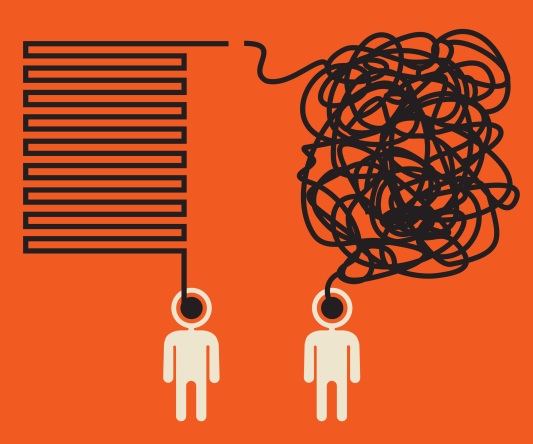
On the other hand, Ralph and I have always had our worst conversations at night when we are tired and Ralph has had some drinks.

dialogue two.jpg

So last night while I was trying to relax after a long day by watching mindless TV at the kitchen table, Ralph stormed out of the bedroom.

“What was the name of that real estate agent who tricked you into selling too cheap?”

I told him the names of the agents we used, one a friend of his. He grumbled some more and went back to bed, only to return moments later and begin to rant about how we were cheated and I should have known better.

He was talking about some property we sold in 2013, the year he got his diagnosis and was still half running things. He had chosen the agent and begun the negotiations pre-diagnosis; I had completed the deal post-diagnosis. Ralph and I had discussed the terms exhaustively. I didn’t want to sell the building at the time but he insisted.

Those months were among the worst in my life, a time I’d rather not remember myself, filled with my mother’s precipitously failing health, Ralph’s heightened, often angry anxiety over his diagnosis, our desperation to sell our business profitably, the sharp learning curve I had to master while laid up in a cast after I crushed my ankle falling on black ice. I did not necessarily make stellar business decisions, but frankly I handled it all pretty damn well considering.

In Ralph’s head last night, we had sold the property just weeks ago and he was obviously obsessing over the numbers (which he had wrong). As he began to berate me, I pretended to be absorbed in Saturday Night Live. In fact I was stewing in resentment and in memories of Ralph during the middle years of our marriage when I often felt he bullied me.

Then he switched gears.

“Where’s our money now? Who are those people who supposedly manage our investments? How do you know they are not going to take our money? You need to make sure they can’t steal our money.”

What I felt as he ranted was about as far from protective affection as you can get—hot white hate tinged with damp self-pity that I was stuck with him until one of us died.

This morning Ralph brought me coffee in bed, as sweet as could be. The conversation has erased itself from his brain as if it never occurred. I wish I could say the same, but I can’t.

 …xxx…


*A side note: as we were entering the examining room, the nurse behind the desk said to another nearby, “The Alzheimer’s patient is here now.” I clearly heard and am sure Ralph did too, but neither of us brought it up, not even in the car.


RALPH TRAVELS TO BABYLAND WITH MIXED RESULTS

IMG_1222.JPG


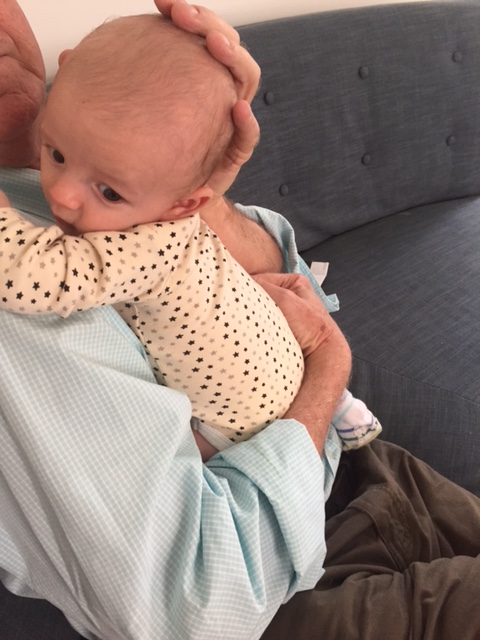
The picture above of Ralph holding his namesake may be a bit misleading. During the recent ten days Ralph and I spent in New Orleans to hang out with our now three-month-old grandson, Ralph held babyRalph exactly twice.

And that was after much prodding.

But he did hold him. And he did survive ten days away from the farm. (In fact I had booked an airbnb for ten days knowing we might leave early if necessary.) So over all, I’d say it was a victory, a pyrrhic victory…

He was not unhappy. Our son came down from NYC to surprise Ralph and meet babyRalph. Big Ralph was pleased and quite animated the first night. After that he read his book and napped a lot on the couch while the rest of us cared for and played with babyRalph in the next room.

Mostly Ralph drank coffee or beer and smoked cigarettes on my daughter’s front porch. Pretty much the same way he fills his time at home. Fortunately, my daughter recently moved into a renovated New Orleans shotgun with both a front porch. By the second day, Ralph had met pretty much everyone on my daughter’s small street where the neighbors all interact —white, black, Latino, gay and straight, elderly and hipster. Everyone thought Ralph was charming because while talking to strangers who demanded only the smallest small talk, he came to life. But with us inside, he was slightly removed, in a vague fog or intimidated by the hubbub surrounding the baby.

Frankly I found grannynannying while watching out for Ralph exhausting. Physically exhausting because I was running him back and forth from the airbnb where he slept twelve hours every night while I helped with the baby’s early morning feedings. And definitely emotionally exhausting as I tried to be grandmother, mother, wife and caregiver.

On the drive home, we shared what has become a rare moment of genuine conversation. Ralph acknowledged that travelling seems to make his memory worse, that leaving the comfort of his routine was difficult for him. I said I could see that. Then we went back to listening to a Bob Dylan cd.

But the unspoken message hung in the air—no more travel for Ralph.

Moment of Reflection: Where We are On Our Alzheimer’s Journey

journey.jpg

Last week I had the opportunity to speak on a panel about caregiving in to a group of nurses and nursing students at Emory University in a conversation titled Lived Experiences in Coping. The other two members of the panel, the wife of a man with Parkinson’s and a woman who has MS, were actually nurses themselves so I was a bit intimidated at first, but I think I held my own (although I fear I went beyond my 15 minute time limit). And it was a fascinating morning as we shared perspectives and answered questions from the professionals who asked over and over what they could do to improve the care experience.

As valuable as the meeting was, what was most useful to me was the preparation. In the invitation to speak I was asked to discuss how we arrive at Ralph’s diagnosis, and how the news and illness trajectory have affected my and Ralph’s lives.

Not surprising questions or ones I haven’t thought about in the past, but ones I have avoided thinking about for a while. I used to take stock regularly to keep perspective, but lately it’s been easier (i.e. less scary or anxiety producing) just to rock along day by day without considering the long picture and the implication Being asked to talk at a symposium forced me into that area of necessary discomfort.

So what I jotted down:

Diagnosis came in 2013. Before that I didn’t want to think his memory problem was serious in part because his failing memory coincided with a personality change I liked. In fact I realize that for those few pre-diagnosis years we were in a SECOND HONEYMOON—he was less angry than he had been as a younger man and a sweetness emerged that he had not shown before. If he was secretly stressed, I didn’t choose to notice.

Then for maybe six months before the diagnosis, Ralph went from forgetful to what I found at the time annoyingly inattentive. I thought he wasn’t paying attention when I had to repeat things over and over. And he was often argumentative at night, so we went to bed angry at each other, but while I’d wake up still angry, he’d wake up denying there’d been any friction the night before. But still we were closer than we’d been for years.

Then his memory tripped him up more obviously—I have written about the fishing trip that made him realize something might really be wrong because he couldn’t keep up with the other guys—and he saw our family doctor who sent us for tests. Ralph and I were convinced he had Lyme’s disease.

Between taking the tests and learning the results we went from honeymoon to LIMBO. In real time I am only talking about a month or two from test to first diagnosis and another three months until we saw Dr. Lah at Emory’s Brain Clinic. But the period felt much longer—one of those crucial moments in time that stretches as if time has slowed down to allow for the heavy significance. We didn’t know much about Alzheimer’s. We were both anxious. Neither of us knew exactly what to expect but we were talking about it A LOT. I remember a car trip, six hours talking away, feeling oddly close as we faced an uncertain future together, both of nervous but open and oddly upbeat. The ride was actually kind of fun.

Then we got the diagnosis and went from Limbo to PURGATORY. One day he was one person, the next he was someone else. Not that his condition changed, but one it was NAMED, it was much more scary. Suddenly he was terribly, terribly anxious and suddenly I felt the need to limit plans, to take over his business (and close it), to act as a buffer between Ralph and all the people who didn’t know he had an actual condition that was causing him to act certain ways. Purgatory lasted for a long while. He seemed to slip dramatically and then, once he began his drug regimen, he regained some ground, only to slip a little more over time. His memory did not get worse—it was already terrible in the first tests—but slowly other aspects of the Alzheimer’s spectrum showed up, like passivity, lack of time awareness, loss of sense of direction, withdrawal from the world, and a general malaise along with the frankly beneficial loss of memory of all arguments and disagreements as he embraces those with whom he had fallings out. My symptoms as caregiver also showed up—greater impatience and loneliness balanced by a kind of desperate energy and new to me gregariousness as well as moments of patience I didn’t think I could manage.

For a while now, we have been on a PLATEAU. Ralph has been holding steady more or less. Some days he’s more with it than others. But I can’t really see much difference from week to week.

The big difference is in expectations. It’s not that I have bad ones. Or not exactly. I have none at all. The rule of thumb is that Alzheimer’s progresses, but the rate is so varied that I have no clue how it will progress in our case, what route it will take or how long. But I do know that when we move from this plateau, the next stage will not be good.

Alzheimer’s and Nurturing Men

shutterstock_490349392.jpg

I was picking out apples at the grocery story yesterday when I noticed a woman having a kerfuffle over by the oranges. After she knocked over a small display, her husband rushed to her side and gently steered her away. As I picked up the display, I couldn’t help watching how he spoke quietly to allay her anxiety and confusion. Walking walked past him on the way to the spinach, I whispered, “You are a lovely man.” (To be clear I was not being flirtatious and he was definitely not lovely in any literal sense.)

A few moments later we found ourselves standing together by the avocados. I explained to him that I spoke to him because I wanted to make sure he got credit for the nurturing way he dealt with his wife. I said I understood his situation as a spouse caregiver myself. The look of calm that washed across his face was different that gratitude or relief, was closer to what I imagine war veterans must feel when they connect. We talked for maybe a minute or two and then I moved on before he could see that I had tears in my eyes.

One of those brief moments that reverberate and reverberate.

But it got me thinking, not for the first time, about how much harder it may be for husbands than wives, at least those of my boomer generation. We were a generation who adopted feminism but were not born to it. There was a lot of intellectualizing about women and men’s roles, but there remained an emotional pull to the way we were raised. The men, however “progressive” or “liberal” or even “radical,” paid lip service but under the surface, our roles only shifted so far.

So men now in their fifties, sixties and seventies with wives who are struggling with impairments are having to learn to nurture the way women in similar situations have known how all along. And men like my grocery store friend are stepping up. I am amazed at their openness about how hard it is and their willingness to go all out. Frankly they often seem more open and more willing than I am.

Like many a good feminist of my generation I have never been above a little vicious, resentful man-bashing, let alone husband-bashing. But this is my little shout out to the guys. We are all in this together.

Alzheimer’s Benefit–Exposing A Goodness Quotient

shutterstock_457376863.jpg

I am prone to cynicism in general. And like a lot of people, I have been more demoralized by the state of the world than usual lately. So I am a bit surprised to find myself celebrating what, for lack of better phrase, I’ll call the goodness quotient in human beings.

Martin Luther King Jr., Gandhi, Anne Frank, Nelson Mandela, Saint Francis—their lives are awe-inspiring and intimidating in equal measure. They have had their human imperfections here and there, but few of us aspire to their level of goodness. At least I never have. (In fact, I admit to spending MLK Day sitting around the house when I should have been out volunteering.)

But after reading the recent spate of articles surrounding Reverend King and John Lewis as well as a post entitled Gratitude in the Land of Dementia on the blog One of Life’s Little Surprises, I am struck by a reality that I seldom consider, the capacity of so many “normal” people to help others.

In particular, how do so many people find themselves able to accept challenges and responsibilities they never imagined they would face when their loved ones became increasing cognitively impaired. Why don’t they walk away (as I am often tempted to do from a so far less difficult situation)?

Individuals may answer, “I love my husband/ wife/ mother/ father/ sibling/ friend/ partner;” but that’s not it, not in any conventional sense. Of course I can’t speak for anyone else when I acknowledge that whatever emotional chemistry existed between Ralph and me before his diagnosis—whether the early passion or deep marital affinity—has definitely altered since his mind and identity have altered along the Alzheimer’s spectrum. I suspect the same kind of alteration has occurred between other caregivers and caregivees.

So, what specifically is the mix of loyalty, generosity, duty and sympathy/empathy that makes so many of the caregivers I’ve run across (who know who you are, Mary, Nancy, and all you others) tick?

I certainly don’t have an answer, but it is heartening to realize that when faced with the challenge, a large number of flawed, normal people are capable of being kinder and more caring than we expected of ourselves

Alzheimer’s Friendship

lunch.jpg


Last week I had lunch with a new friend.

A month or so earlier I received an email from E responding to a post. She mentioned that we once met at a support group meeting run by the Emory Brain Center. I didn’t recognize E’s name so wasn’t sure who she was; because of the distance involved, I attend the support group infrequently at best and haven’t been back for ages.

But as soon as I saw E in person, I remembered her. I remembered sitting across the conference table from an attractive woman whose name I didn’t catch and thinking  she is really angry—angry and exhausted—and what’s more, she’s willing to admit it! She had recently convinced her husband to downsize their home, only to realize in the selling, packing and moving that her husband was more incapacitated than she’d realized. Scrunched down in my seat, listening to E talk so honestly, I recognized that I was not facing my own complicated mix of anger, stress and protectiveness toward Ralph. E’s directness and her honesty were a truly liberating epiphany.

Now here we were over a year later, sitting in a café catching up, and as E said, it was “like looking in a mirror.” Our husbands had different careers but in many ways we shared similar lives before they were diagnosed with Mild Cognitive Impairment within months of each other and began seeing the same neurologist at the Emory Brain Center. Now both men are enrolled in the same Merck study I have written about . They both are devoted to their dog. And E and I are both…. Well, we are that same complicated mix of stress and protectiveness.

As E and I sat and talked over our salads last week One of us would begin a sentence and the other would be able it finish it. We didn’t have to sugarcoat, we didn’t have to explain. The words poured out. Being with E was so relaxing.

We lingered and lingered and then we went back to E’s house and talked some more. I drove away almost giddy with excitement, the way I felt at ten or eighteen when I met a new friend.

When Ralph was first diagnosed, one of the vows I made to myself was that I was going to maintain my life, that I would keep my friendships. And I have. In fact I have a larger circle of friends and more active social life than I used to. I have worked at building a network, professional writer friends, volunteer organization friends, political friends, literary friends, movie going friends, fun and conversation friends, family friends.

And online friends through the Memoryland community—and it feels to me like a community—along with other caregiver/caregivee blog communities.

Now I have an actual Alzheimer’s friend.

Taking Stock For Future Reference

In preparation for Ralph taking part in testing of the new Merck anti-plague drug, our nurse at the Emory Brain Center  asked me to make a list for the nurse to show Ralph’s current baseline. Of course, I put it off (just as I often put off writing here because it means facing stuff I may not feel like facing). But now  the list is done and it seems worth sharing.

WHAT RALPH CONTINUES TO DO:

Make small repairs around the house when asked; Pick vegetables and do light farmwork when asked; Take his meds on his own from his filled weekly pillbox; Make his own cold breakfast and lunch; Make coffee as needed; Use the microwave; Buy beer at the convenience store; Feed the dogs daily; Drive around the farm in his truck to “walk” the dogs; Dress, bathe, shave etc on his own; Talk on the phone at length to his sister and oldest son; Attend his art class; Walk occasionally on a farm path circuit; Watch nightly news and Jeopardy over dinner; Listen to NPR on the radio; Read quality full length books of fiction and non-fiction; Use his credit card (as long as no tips are involved); Pay cash for small purchases; Cut his own hair ; Turn on the gas grill and change the gas canister when needed; Interact socially with people who visit or whom we visit; Fish from a dock; Clean fish he catches; Share stories from his childhood; Offer witty one-liners out of the blue; Analyze a situation/problem presented to him and show insight even though he forgets his analysis (and the problem) shortly afterwards

WHAT RALPH CAN’T DO ANYMORE:

Pay attention to business or financial matters—important since his professional life was all about real estate investing and managing; Use the stove; Use the grill although he does turn it on when I ask; Drive on his own except those places noted above or under duress and if I am there to give him directions; Use his boat; Hunt ; Go to movies—says he finds them “boring”; Watch narrative television dramas or comedies except on rare occasions; Listen to music on his own; Keep up with or show interest in family and friend activities; Remember details of relationship history with friends


WHAT RALPH MAY OR MAY NOT DO:

He may still be able to play guitar, but shows no interest; He says he can drive tractor (and was told it would be ok by Stephanie) but avoids doing so.; While he goes to art class, his output has greatly diminished; he spends most of his “painting” time sitting in his office smoking and listening to talk radio; He claims to take walks but I have not witnessed him walking


RALPH’S TEMPERAMENT CHANGES:

Extremely passive—used to be extremely assertive; Never gets angry—used to be hot tempered; Without curiosity—used to be extremely curious and factually knowledgeable ; Emotionally totally focused on his dogs; Less outgoing but more jolly most of the time.  

I kind of love having this information down in black and white and red and blue and green.  In a year or two or five, I will look back at what I recorded–whether with relief that the Merck pill has worked to keep Ralph at his current activity level or in bittersweet nostalgia for this time when the Can Dos on Ralph’s list are several lines  longer than the Can’t Dos and Maybes list combined. May it stay this way for as long as possible.


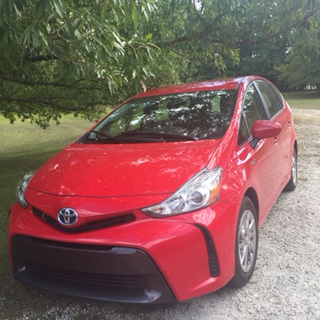
My Car Is My Caregiver


img_0598

Dear Red Prius,

My first car was a bright blue sedan that I drove to Atlanta when I was 22. I don’t remember the brand, only that I hated how visible it made me, especially since I was not the best driver.

I traded the blue bomber in for a used telephone “van” that had been refurbished by Ralph—his first entrepreneurial venture was buying and fixing  up used phone trucks, then selling them to counterculture types like me; the streets of Midtown Atlanta were full of Ralph’s trucks in the early 1970s.

The brakes went out on my van a week after I bought it. I was rounding a curve and ended up down an embankment. Fortunately I wasn’t hurt. Naturally Ralph felt terrible. He helped me fix the van and sell it.

(Actually, Ralph disputes my car history, says I got the blue bomber after the truck disaster, and he may be right. In any case I don’t remember what I drove next.)

We got married five years later, and for the next multiple decades I drove a series of practical, second-hand sedans (with baby seats), SUVs (for carpools and horse-trailering), and (once the kids were gone) compacts. They were all non-descript, aside from the dents I added, and I could care less.

A year and half ago, though, I got you,  Red Prius. I bought you for practical reasons like gas mileage and comfort, etc., and I admit that I chose your red color because you were cheaper than the silvery blue model.

The irony is that these days what I love most about you is your color. It makes you  So Visible, so easy to spot among the sea of tans, blacks, grays and whites on every road and in every parking lot.

I often find myself writing here about the difficulties, the frustrations, the borderline depression care-giving causes me. I think one of my secret worst fears is that my memory is going too. I said this to a friend recently and she laughed, “But Ralph isn’t contagious.”

Maybe not, yet I often feel as if my brain is clogged with the details of thinking for two. An adage of care-giving is that if we are tense or irritable, our cognitively impaired spouses (or parents) sense and react in kind. The flip side is that I am vulnerable to catching Ralph’s anxiety, and when I’m anxious my brain does not function at its best.

Lately I have an urge to simplify: the less I have to worry about the better. Less stuff means less stuff to keep organized and clean without Ralph’s help. Fewer commitments mean fewer complications to arrange for Ralph. But I also want to stay active and involved. Simplification can be a slippery slope that I don’t want to begin sliding down too fast.

Red Prius, you have been a godsend. It takes one item off my overloaded mental table—no more walking out of the supermarket or doctor’s office or bank or lawyer’s meeting or movie theater or restaurant or political meeting worried where I parked. One glance each way or a click of my key button and there you are, Red Prius, brightly reminding me that I am in control, at least to the best of my ability…A small comfort maybe, but it’s the small comforts that count.

So thanks for making my life better Red Prius. I promise to take care of you as well as I take care of Ralph.

Gratefully,

Alice


ALZHEIMER’S CALENDAR GIRL


calendar girl

For everyone who has MCI or Early Alzheimer’s or who lives with someone with these forms of loss THE CALENDAR IS KING (QUEEN).

You don’t have to have memory loss to have trouble keeping up with scheduling complications of course. Dental appointments, meetings, pick up times, they all swirl through our lives and seem to swirl faster now with the advent of electronic calendar keeping. In fact my highly intelligent, mentally acute son texted me two weeks ago to arrange when he would pick me up from the airport that day, only to have me tell him I wasn’t arriving for my visit until a week later. LOL. Haha.

Still, driving Ralph home from his dental appointment yesterday morning, clutching the little card that noted the dates for his next two appointments, repeating to him the dates fifteen minutes later as I wrote them down on our big kitchen calendar, then again last night when he asked, and again this morning when he asked as soon as he woke up, it struck me how much of our daily life now revolves on what used to be a taken for granted detail.

In my first support group for dealing with newly diagnosed Mild Cognitive Impairment at the Emory Memory Clinic, there was discussion of calendar keeping—one man explained that he printed up a schedule daily for his; others had taken classes in calendar keeping—but I didn’t pay much attention. At the time, Ralph, who in his business life was always a stickler for keeping precise calendar records, still carried around his mini-notebook calendar. And frankly his life was not so busy that I thought it would be hard to keep up.

Well, his life is less busy now, so keeping up is not exactly a problem. He gets everywhere he needs to. But keeping track has become an obsession, really for both of us. As soon as there is something coming up, whether a dental appointment or a dinner date, or any other minor routine change of plans, the discussion of WHEN becomes endless. As usual the underlying issue is anxiety. But I think the matter of keeping up with days and calendar dates dominates over every other issue in our lives right now.

I gather many caregivers of those on the Alzheimer’s spectrum, especially spouses and children, deal with this WHEN problem. I am never sure I am dealing with it as well as I should but we muddle along. We have an erasable board that tracks the weekly schedule. And we have a large book calendar that I found at Office Depot; I looked at every one in the store and the best one for our needs includes a monthly at a glance as well as the weekly at a glance. And frankly his week-long pillbox is the best reminder of all what day it is.

IMG_0362

Ralph will take his pills and then, sometimes go read the weekly calendar. He rarely looks at the big calendar, but once in a while it comes in handy for him to get a time line straight. He does not have a calendar on his phone and has never learned to use a computer.

The fact is that Ralph doesn’t need to know what day it is most of the time. And he doesn’t need to know when his next eye doctor appointment is ahead of time. But he often wants to know. And then wants to know again and again.

As for me, I am having a little trouble letting go of my need to have him know things ahead. The marital habit of talking about the details of an upcoming birthday party, a worrisome doctor’s appointment, a visit from or to our kids, is hard to break. And I have not solved the basic conundrum:

Does bringing up what is coming up days or weeks ahead creates unnecessary tension for Ralph and is it a waste of time anyway since he won’t remember? Or does carrying on a conversation about future events, even if it means carrying on slight variations of the same conversation many times, have value in maintaining Ralph’s involvement in his own life whether he remembers or not?